




The National Economic Council is alarmed at the rate at which Nigeria’s solid minerals are being mined and stolen and has therefore expanded the mandate of its Ad-hoc Committee on Crude Oil Theft Prevention and Control to cover mining.
Imo State Governor, Hope Uzodinma, who is chair of the committee, told journalists in Abuja on Thursday that the expanded mandate is part of government’s efforts to curb resource theft and increase revenue from Nigeria’s solid minerals sector.
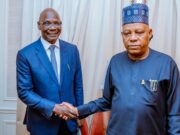
He spoke while briefing State House correspondents after the 153rd NEC meeting chaired by Vice President Kashim Shettima at the Presidential Villa, Abuja.
He said the committee would coordinate with the Ministry of Solid Minerals Development and other federal and state institutions to combat widespread illegal gold mining and other forms of mineral smuggling that have deprived the country of much-needed revenue.
This is even as a recent report from the federal budget shows the FG earned N4.6 billion from solid minerals in the fourth quarter (Q4) of 2024, representing a 303.56 percent increase from the previous period.

The office said N1.61 trillion was received from oil sources in the fourth quarter, falling short of the quarterly estimate of N2.04 trillion by N427.81 billion or 20.93 percent.
It added that the sharp rise in solid minerals revenue reflects ongoing efforts to strengthen non-oil revenue sources and diversify government income streams.
“The National Economic Council Ad-hoc Committee on Crude Oil Theft Prevention and Control, which I chair, presented an interim report today to the Council, ” Uzodinma said.
“NEC received our report with satisfaction and expanded our Terms of Reference to now also take interest in solid minerals, because our solid minerals are being mined and stolen and not adding to national revenue. ”
The committee was first established under former President Muhammadu Buhari in August 2022. It was reconstituted under President Bola Tinubu in December 2023 with Uzodinma as chairman.
Its creation followed rising oil theft that had crippled national production and forced international oil companies to shut down key pipelines.
The governor said through a “collaborative approach” involving regulators, operators, and the security forces, the committee had helped raise daily crude oil production to over 1.7 million barrels per day in the past 22 months.
“Before May 29, 2023, when President Bola Tinubu was sworn in, our crude oil production was around 700,000 to 800,000 barrels a day.
“Working with stakeholders, the regulators, operators in the industry, and the Navy, we were able to involve all the governors of crude oil-producing states and raise different security organisations.
“You would agree with me that as I speak, daily production is now in excess of 1.7 million barrels a day, and cases of pipeline vandalism and vandalisation of oil assets have also been on the decline.”
The council, he said, was satisfied with the progress and decided to deploy the same model of intergovernmental coordination, private-sector partnership, and multi-agency surveillance to the mining sector, plagued by resource theft.
“We are determined to ensure that crude oil production and gas are properly preserved for the benefit of our citizens.
“Now, with this new directive, we will also protect our gold and solid mineral assets,” Uzodinma added.
Nigeria’s illegal mining economy, particularly in gold, lithium, and other high-value minerals, has grown into a multibillion-naira shadow industry, he said.
A NEITI report shows a Nigeria records an estimated $9bn loss annually to illegal mineral extraction and smuggling.
According to Uzodinma, the expanded mandate aims to integrate the fight against illegal mining into the broader national resource protection framework previously used in the oil sector.
“We have done well,” he claimed, adding, “Among other things, we recommended that NNPC, working with security agencies and their consultants, should strengthen security in all the creeks and extend coverage to offshore regions. That will help in curtailing and supervising illegal entries and exits of vessels into our export terminals. This same spirit will now guide our solid minerals sector.”
The committee is expected to submit its first progress report on the expanded mandate at the next NEC meeting in November.