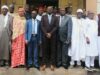


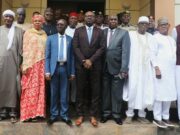
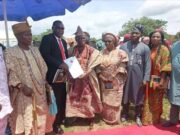
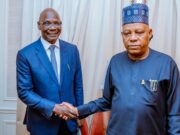


Pix l-r: Prof. Olusegun A. Wright; Mr Abiodun Oni; Akeem O. Amosun; B.B Shetima; Engr. Adeniran Ajibade and Mr Dele Ayanleke at the event…
A speedy implementation of the new solid mineral data rendition template for effective revenue monitoring is welcome as it will ensure prompt and accurate remittance of mining revenues to the Federation Account.
Oyo State Governor, Seyi Makinde, stated this on Monday in Ibadan during the South-West Zone sensitization exercise on the ‘Implementation of the new solid minerals data rendition template for effective revenue monitoring’.
The event was organised by the Revenue Mobilisation Allocation and Fiscal Commission (RMAFC) for solid minerals stakeholders from the Southwest region.
Also in attendance was the President of the Miners Association, Dele Ayanleke; representatives of the Federal Ministry of Solid Minerals Development and state officials of the Miners Association of Nigeria.
The Lead Resource Person and Managing Director of Architype Industries, Engr Adeniran Ajibade, presented a paper on “ General Overview of the Global/Nigerian Mining Sector: Assessment of Revenue Contribution Using Data Rendition”.
Governor Makinde, represented by the Director-General of the state Solid Mineral Development Agency, Abiodun Oni, told the gathering that an implementation of the new template would ensure prompt and accurate remittance of mining revenues to the Federation Account.
This, he said would happen through enhanced real-time tracking of production volumes across mineral types; identify new opportunities for investment and development; strengthen compliance with mining and fiscal regulations; and support evidence-based policy decisions for the sustainable growth of the sector.
Makinde said that the solid mineral sector remains one of Nigeria’s most promising pathways for economic diversification and revenue expansion.
Makinde noted that though the nation is blessed with mineral wealth deposits, the sector faces challenges such as poor data reporting, weak monitoring and revenue leakages.
Despite this, the “solid mineral sector remains one of Nigeria’s most promising pathways for economic diversification and revenue expansion,” he said.
Chairman of RMAFC, Dr M.B. Shehu, said the implementation of the new data rendition templates was critical to diversifying the nation’s revenue sources.
Represented by the Chairman of its Solid Mineral Monitoring Committee, Ibrahim Shetima, Shehu described the new data rendition templates as invaluable to diversifying the nation’s revenue sources.
He said: “The implementation of the new data rendition templates could not have come at a better time, given the current economic difficulties our country is experiencing at the moment. The need to diversify the nation’s revenue sources cannot be overemphasized, primarily because of the perpetual overdependence on hydrocarbon sources of revenue, which is often plagued by the vagaries of the international oil market, in addition to other reasons, which include shut-ins resulting from pipeline vandalisation and crude oil theft. “.
The new data rendition templates were designed to capture and manage relevant data regarding specific measurements of quantity of minerals produced, producing companies and their locations, particular licences, fees and permits paid by mining companies.
“These data, we believe, if properly managed/utilised, would go a long way in ensuring that mining operations and revenues from there would be more effectively tracked and accounted for. Consequently, the commission is here in Oyo today, with its partners in the country’s mining sector, to unveil the implementation of the new data rendition templates, developing the necessary synergy required to boost mining operations and resultant revenue accruable,” he said.
The Federal Commissioner who represented Ogun State at RMAFC, Akeem Amosun, said the program was organised to bridge the observed gaps in the rendition of timely and accurate revenue data on a state-by-state basis by agencies of government and operators in the solid mineral sector.
“The exercise is also primarily aimed at ensuring the existence of a platform for an independent data source for the commission, which would be free of summation errors and can be used for comparison and as advanced information for attribution purposes,” Amosun said.
He stated that Nigeria still has a long way to go in terms of solid mineral exploration, and also the amount being generated into the Federation Account in comparison with other countries of Africa, adding that the solid mineral sector contributes only 0.7 per cent to the Gross Domestic Product.
“We know that Nigeria is much endowed; we have a lot of resources. There’s no local government in this country, out of the 774 local governments, that you will not find, at least, one solid mineral. And so the question is, why do we have such a marginal percentage of our gross domestic product? That means we have a lot to do in that area, and that’s what we are trying to do,” he said.