


By Adesuwa Dan- Princewill, Legal Contributor, The Miners Magazine
The mining industry, once a quiet backend sector, now sits at the heart of the global Energy Transition. Internationally, the demand for “transition minerals” including lithium, cobalt, copper, and rare earth elements is projected to skyrocket by over 400% by 2040 to meet the needs of clean energy technologies.

In Nigeria, this global scramble for mineral resources is a game-changer. It places the nation’s vast, largely untapped solid minerals sector, rich in gold, tantalite, and high-value gemstones, front and center as a critical component of economic diversification.
Historically, the sector has been overshadowed by oil and gas, contributing a meager 0.3% to the nation’s GDP (Q3 2022), a stark contrast to the historical target of 3.0% by 2025.
The foundational legal shift began with the Nigerian Minerals and Mining Act (NMMA) of 2007, which aimed to create a transparent, market-oriented framework to attract private investment. However, its effectiveness was undermined by pervasive illicit mining, which, according to some legislative estimates, costs the country up to $9 billion annually.
This challenge is compounded by the fact that Artisanal and Small-Scale Mining (ASM) activities are estimated to constitute over 70% of the sector, much of which remains unregulated. To counter this, the current administration, under the Minister of Solid Minerals Development, Dr. Dele Alake, is driving a transformation encapsulated in its Seven-Point Agenda.
This includes setting up the Mining Marshals to combat illegal operations and introducing a new policy mandating that every new license must include a plan for local processing and value addition before export. This aggressive enforcement has already led to a sharp rise in sector revenues, which grew from ₦6 billion in 2023 to a record ₦38 billion in 2024.
The recent revocation of 1,263 mineral licenses by the Federal Government is a decisive step to sanitize the solid minerals sector. This action, driven by the holders’ default in paying their annual service fees, aims to eliminate speculators and open up opportunities for serious, financially capable investors.
The government’s stance underscores a zero-tolerance policy for “license racketeering,” with the Minister emphasizing that the era of obtaining licenses only to keep them in drawers for the highest bidder is over. Furthermore, the outstanding debts are not pardoned; the list of defaulters will be forwarded to the Economic and Financial Crimes Commission (EFCC) for recovery, signaling a commitment to due diligence and accountability in the sector.
While no one can question the revocation of licenses due to the failure of meeting clear contractual obligations, the subsequent re-issuance must be handled as an opportunity to issue licenses transparently and with sensitivity to broad national interest. The process must guard against undue favour to foreign interests as opposed to local interests, and must not be skewed solely towards deep pockets and monopolistic tendencies.
Globally, mining laws are rapidly evolving to address Environmental, Social, and Governance (ESG) criteria. Nigeria is actively aligning its framework by strengthening core legal requirements:
Community Development Agreements (CDAs): The NMMA 2007 makes the CDA a mandatory and legally binding requirement (Section 116) for all holders of Mining Leases. This ensures mining companies commit to the social and economic contributions necessary for the sustainability of their host communities.
ESG Compliance: The issuance of new licenses, which saw 867 mining titles approved in a recent drive, now prioritizes compliance, helping the sector move toward a responsible and investor-friendly environment.
Simultaneously, the AI Revolution is reshaping mining. Legally, this introduces urgent challenges related to data ownership, cybersecurity, and the future of labor laws. Nigeria must proactively develop regulations that govern the deployment of AI to ensure safety, efficiency, and data integrity within its mineral cadastral system.
The geopolitical intensity of the mineral scramble for Africa demands that Nigeria’s legal strategy prioritizes national interest and local value retention. This consensus is being championed through continental platforms.
The Nigeria Mining Week (NMW) is an investment Platform for investment promotion. The events focus is on Nigeria’s abundant mineral potential, latest technological advancements in mining. It’s often hosted by the Ministry of Solid Minerals Development and the Mining Cadastre Office (MCO), in partnership with the Miners Association of Nigeria (MAN) and international event organizers.
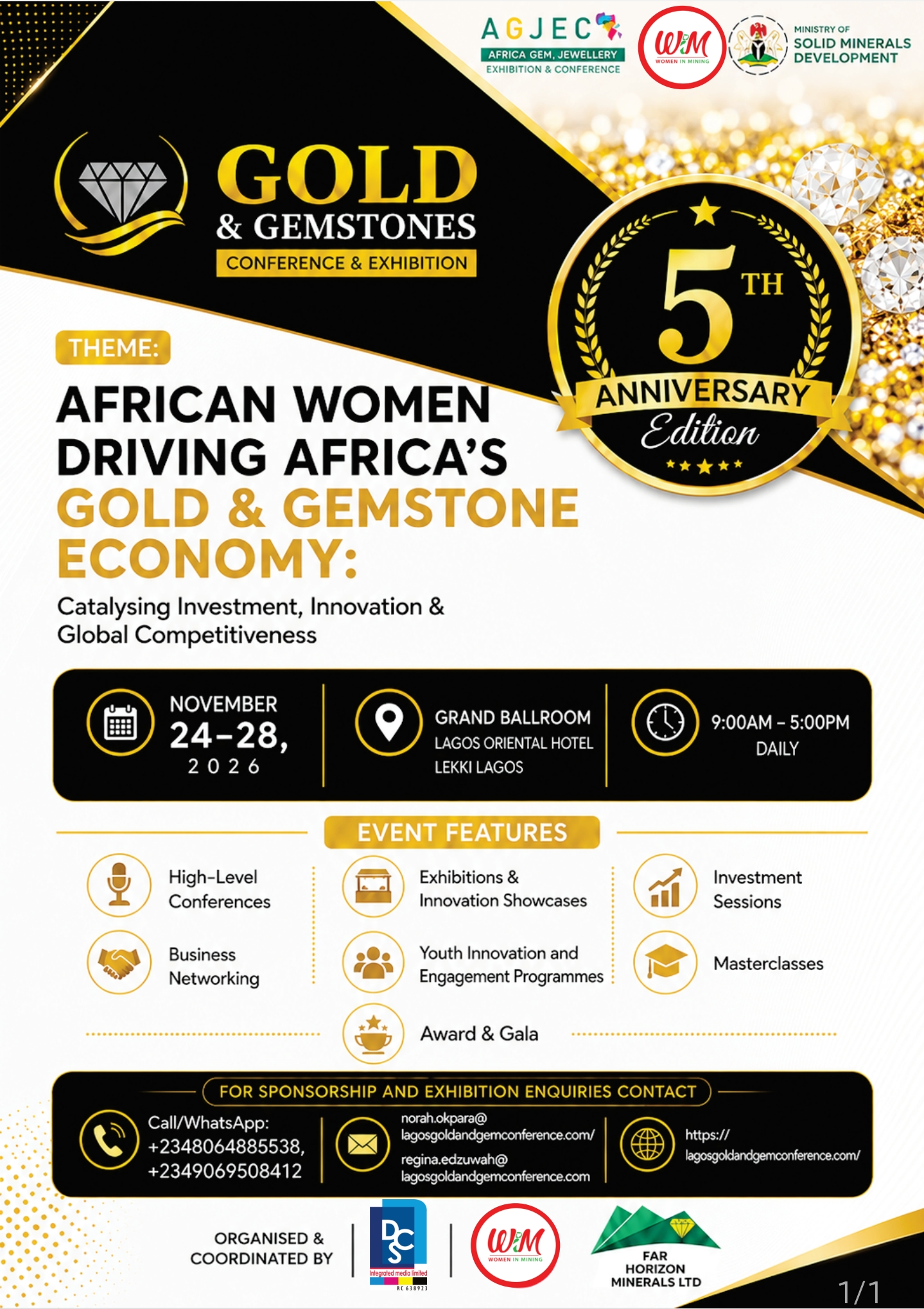
In 2022, Women In Mining In Nigeria (WIMIN) initiated the Gold and Gemstone Conference and Exhibition (GGCE). This WIMIN brainchild achieved a major strategic win: its formal adoption by the African Minerals Development Centre (AMDC) as the African Gem and Jewelry Exhibition and Conference (AGJEC). This model is now being replicated in five African countries, namely Egypt, Zambia, Kenya, Ghana, and Cameroun, signifying a unified African consensus on prioritizing value addition.
The GGCE 2025 capacity building workshops and masterclasses are set to feature some of Nigeria’s best lapidarists and jewelers as instructors, including the renowned international Master Jeweler Mr. Labi Kapo. Kapo is widely celebrated for his bespoke, luxury gemstone pieces and his commitment to developing local African talent, having been instrumental in training a new generation of high-end artisans. His participation is a major boost to the “mine to market” mandate, ensuring that local skills match international standards.
The Fashion Fusion Runway Show at the GGCE directly solidifies the powerful link between mining and the high-growth fashion industry. This is symbolized by the Miss Universe Nigeria Crown, a powerful metaphor for the entire “mine to market” cycle: designed, crafted, and fully sourced with Nigerian gemstones and precious metal.
This deliberate linkage encourages Nigerians to pair made-in-Nigeria apparel with made-in-Nigeria jewelry, successfully moving the country from merely exporting raw minerals to exporting finished, high-value cultural and industrial products.
The current season presents a profound opportunity, but Nigeria must act decisively. Investing in processing infrastructure, skilled artisans, and a supportive legal framework ensures the revenue generated from our minerals stays here, diversifying the economy and building generational wealth.
The final verdict is clear:
Nigeria must urgently move beyond being a mere exporter of raw materials by prioritizing value addition and strengthening its legal and financial frameworks to support local manufacturing; it must fully prepare itself for the AI revolution and strategically leverage continental platforms like AGJEC to champion “Made in Africa” mined products, ensuring its mineral wealth translates into immediate and long-term prosperity.