





By Shakirudeen Bankole
Mining, at its core, is a business of risk.
From uncertain geology and volatile prices to political instability and community conflicts, the journey from exploration to extraction is fraught with hurdles.
In Africa, these risks are often amplified by infrastructural gaps, regulatory inconsistencies, and limited access to long-term finance.
Yet, the African Continent holds one of the richest mineral endowments on earth, hence a generational opportunity to anchor its future in resource-led industrialisation. The key to unlock this treasure lies in one elusive objective: building bankable mining projects.
In Nigeria, this challenge has become a defining question of the country’s mineral renaissance. With over 44 types of commercially viable minerals and a government committed to diversifying the economy beyond oil, mining has emerged as a strategic growth sector.
But despite the enthusiasm, only aimoted number of Nigerian mining ventures have crossed the threshold of bankability. Many projects stall after exploration, struggle to secure funding, or operate informally without proper feasibility studies, legal structures, or environmental safeguards.
Investors, both local and international, remain cautious, citing poor data quality, governance risks, land tenure disputes, and the absence of viable exit strategies.
At the AFNIS25, experts discussion around bankability of these resources is expected to go beyond mere rhetorical or academic jargons anymore.
Experts say for Africa to truly benefit from its mineral wealth, it must build a pipeline of projects that are technically sound, financially viable, socially acceptable, and environmentally sustainable.
The Nigerian Geological Survey Agency (NGSA) has made progress in digitising national geodata, but budget constraints and weak data-sharing platforms continue to limit investor confidence.
Beyond data, the business model itself needs a rethink. Many local miners operate without bankable feasibility studies, lacking the detailed financial models, cost projections, and risk assessments that banks and private equity firms require.
As a result, projects are viewed as speculative rather than structured investment vehicles. Experts like Dr. Emeka Obiora, a mining finance consultant based in Lagos, had argued that Nigeria must build a domestic project development ecosystem.
“We need pre-investment funds, technical assistance, and project preparation facilities that help early-stage ventures mature into investment-grade deals,” he says. “This is what countries like Peru and South Africa have done successfully.”
The financing landscape is evolving, however. Development finance institutions such as the Africa Finance Corporation (AFC), African Export-Import Bank (Afreximbank), and the African Development Bank (AfDB) are offering blended finance solutions, combining grants, equity, loans, and guarantees to de-risk projects.
Nigeria is exploring partnerships with these institutions to create a Mining Investment Fund that supports pre-feasibility, environmental assessments, and early-stage infrastructure.
The Sovereign Wealth Fund and the Central Bank of Nigeria have also expressed interest in co-financing strategic mineral projects, particularly those aligned with the national energy transition and industrialisation plans.
But finance is only one part of the puzzle. Regulatory certainty is equally vital. Investors require clarity on royalties, taxes, land acquisition, and dispute resolution.
Nigeria’s Mining Act is currently under review, with proposals to streamline licensing, enforce ESG compliance, and promote community development agreements.
The Ministry of Solid Minerals Development is also piloting a “one-stop-shop” model to reduce bureaucratic delays in project approval. However, subnational conflicts over land, royalties, and local consent continue to pose challenges, especially in states where artisanal mining has become a lifeline economy.
Social license to operate is now as important as legal license. Communities in mineral-rich areas are increasingly demanding equity participation, environmental justice, and job guarantees. Projects that ignore these demands face resistance, protests, and reputational damage.
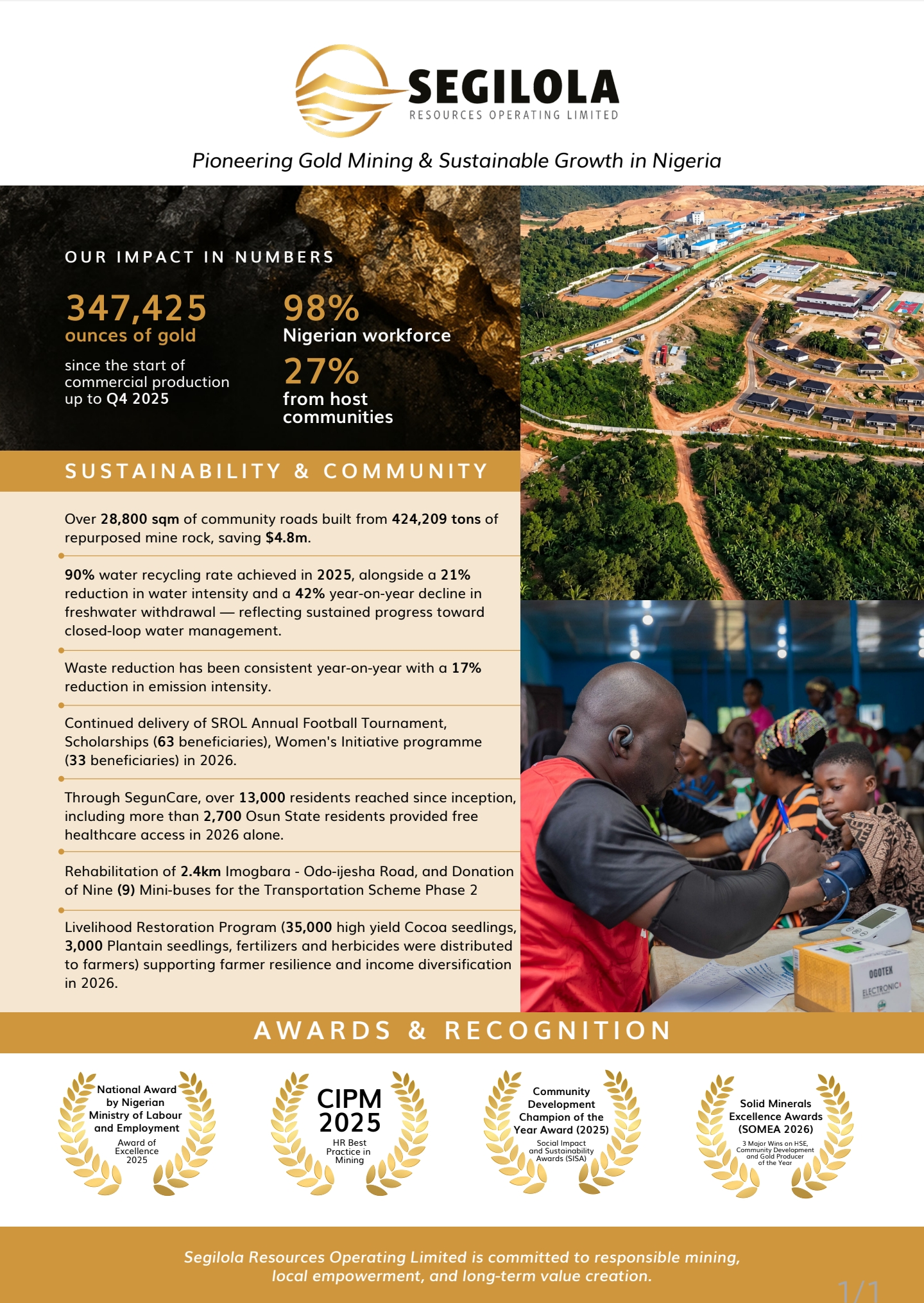
Companies like Thor Explorations, which operates the Segilola Gold Mine in Osun State, have demonstrated that community engagement, transparency, and benefit-sharing are not optional, they are strategic assets that enhance bankability.
Environmental sustainability is another pillar. With climate change shaping investor mandates and buyer preferences, mining projects that fail to align with global ESG standards risk exclusion from capital markets. Nigeria’s emerging ESG framework seeks to institutionalise impact assessments, carbon disclosures, and reclamation plans as prerequisites for project approval.
International certification, such as the Initiative for Responsible Mining Assurance (IRMA) and the Equator Principles, can help Nigerian projects meet global benchmarks and tap into green finance windows.
Technology, too, will play a critical role. The future of bankable mining in Africa is digital. From satellite exploration and blockchain-based traceability to AI-driven resource estimation and drone surveillance, technology offers tools to enhance precision, reduce costs, and ensure compliance.
Nigeria’s mining startups are beginning to explore these innovations, but scale and adoption remain limited due to a lack of technical training and financing.
Ultimately, building bankable projects is not just a financial exercise, it is a governance project. It requires coordination among ministries, capacity-building for local operators, partnerships with technical experts, and platforms for community dialogue. It demands a shift in mindset, from speculative mining to sustainable industrial development.
This is a prime purpose for the AFNIS25 convergence in Abuja, Nigeria.
The stakes are clear. If Africa is to move from being a repository of minerals to a global supplier of green solutions, it must master the art and science of project bankability. For Nigeria, this is not just about attracting investment. It is about creating a mining sector that is modern, inclusive, resilient, and capable of transforming minerals into lasting prosperity.