




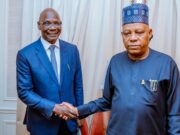


*Nuhu Ribadu, National Security Adviser to the President
By Kayode Ogunbunmi, Yahaya Abdul-Qudus Shola and Patrick Odiegwu
Recently, state governors met in Kaduna along with leaders of traditional institutions to deliberate on the scourge of insecurity that has held the region, even more than other parts of Nigeria hostage and has placed Nigeria within the crosshairs of revanchist US administration.

The session, held at the Sir Kashim Ibrahim House under the auspices of the Northern States Governors’ Forum (NSGF) and the Northern Traditional Rulers’ Council, focused on what the leaders described as a worsening insurgency that continues to sweep through most northern states.
Much was expected of that meeting, especially as the banditry has placed Nigeria within the crosshairs of revanchist US administration since it was conveniently packaged as ‘Christian genocide’ by a section of the survivors of the violence.
Three key decisions were agreed on by participants at the meeting. These are:
*The leaders called on President Bola Tinubu to order a six-month suspension of mining activities across the North, describing it as a necessary step to disrupt criminal networks and curb the escalating wave of banditry.
*The leaders agreed to establish a monthly N1 billion Northern Security Trust Fund.
*The leaders reaffirmed their collective push for the creation of state police.
We are of the opinion that the first demand, for the Federal government to shut down mining activities for six months, sums up the lack of seriousness towards tackling banditry that many have accused some northern leaders of.

To start with, asking the Federal government to act in shutting down mining activities is classic example of political subterfuge and dereliction of duty. This call merely served to push the responsibility for taking such a decision that is likely to be economically suicidal on the laps of the Federal Government while northern leaders wait in the wings to reap whatever benefits there might accrue therefrom, while shielding themselves from any possible harm that might similarly accrue.
To be clear, northern governors need not wait on the federal government to ban illegal mining activities in their states. Indeed, several of them have used the pretext of banning illegal to go after legitimately licensed miners in the past.
Recently, the governors of Niger, Plateau, Borno and others suspended mining operations in their states. Some southern states governors had done the same. These governors could have told their colleagues at the Kaduna meeting they didn’t need Abuja to help them close mining sites, if they found it necessary to so do.

It therefore means the call was more a political statement than a genuine effort to stop insurgency. It also questions the leaders’ assertion that mining is responsible for the upsurge in insurgency and that a closure of the mines would quell the violence.
Let us look at the example of Zamfara State. Government only last year lifted the ban on mining in that state after close to five years of closure. Yet, for the entirety of the time that the ban was in place, there was hardly a month that reports of kidnappings and attacks on communities did not occur.
The armed marauders were not attacking or kidnapping mining workers. They were attacking farming communities, rustling cattle and kidnapping villagers for use as sex slaves or objects to exchange for fat ransom. In which way is a ban on mining going to change this equation, other than a fallacious attempt to tag the dog of mining with a bad name in other to hang it?
Leaving out the economic loss that mining operators would incur – and which the advocates of mining ban glossed over – there is even a likelihood that such a ban would be counter-productive as it would render mine workers idle and susceptible to criminality.
This exactly was the position of the president of the Miners Association of Nigeria, Chief Dele Ayanleke. In his response to the ban call, Ayanleke stated that attempt to deny lawful operators access to sites would inadvertently give criminal groups control over mineral resources, enabling them to “weaponise themselves.”
Ayanleke, who rightly described the policy as “misguided and counter-productive,” noted that past experience, particularly in Zamfara State, (as noted earlier) proves that shutting down mine operations does not translate to improved security.
There is no doubt therefore that this jaundiced suggestion of ban in mining is so hugely contrived.
As Ayanleke also helpfully pointed out to the leaders, a six-month suspension would disrupt production schedules, and threaten ongoing investments involving local and foreign partners.

This should be obvious, isn’t it? But it obviously is not if the plan was to obfuscate. By the way, assuming without conceeding that the blanket ban is what is required, what will happen to road construction, building homes, drug manufacturing that needs kaolin, etc?
Someone needs to tell these politicians that governance is for structured, matured and planned minds that speaks when all the facts are considered.
They think that mining is all about alluvial gold and gemstone, when the real mining are for resources that serve as backbone of any nation: sand, lateritic soil, gravel, chipping from granite, limestone, coal, barite (used in oil and gas exploration), phosphate, gypsum, iron ore, feldspar, etc.
It is therefore not helpful to the nation to make such statement as they did. One could even go as far as saying it was not smart. What happens if, at the end of the half year ban, insecurity has not magically disappeared, as it was not likely to unless more serious and smarter prognosis are made?
And this at a time when government is busy positioning and marketing Nigeria as the next hot investment space in the global rush for critical minerals needed to power the looming green economy. The Minister of Solid Minerals just returned from the UK where he participated in Resourcing Tomorrow!
So, what is to be done?
The northern leaders should honestly work together to dismantle the gangs of bandits and kidnappers roaming seemingly unchallenged within their territories. It is something they could do and the monthly security fund they pledged to raise should go towards this. If the states get this done, the federal government would be free to focus its energy on the bigger beasts of ISWAP and Boko Haram.
Government revenue from the mining sector this year was a respectable N26 billion. Experts say we can easily double that next year if the mining sites are secure and mined resources could reach their destinations safely and in a timely manner.
Naturally, this will also lead to a reduction in unemployment and lift many out of poverty.
That should be the goal of our leaders – northern or southern. Escapism is not policy and we cannot afford this dilly- dally again.
*Odiegwu is General Secretary of Association of Miners and Producers of Barite (AMAPOB).
*Yahaya is a Geoscientist and Policy Strategist
*Ogunbunmi is editor at TheMiners.