




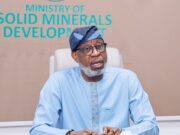

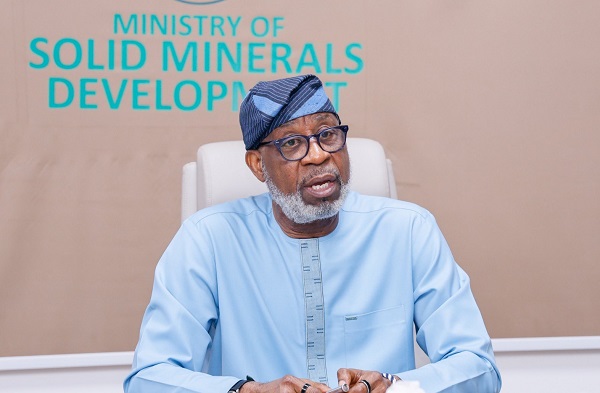

*Dr Oladele Alake, Minister of Solid Minerals Development By Martha Agas/News Agency of Nigeria
Nigeria has more than 44 mineral deposits in commercial quantities across 500 locations, including lithium, gold, tin, tantalite and barite.
Translating this resource base into investment, local processing and sustainable economic growth remains a major challenge.
Amid rising global demand for critical minerals driven by the energy transition, Nigeria has an opportunity to diversify its economy through solid minerals.
Realising this potential will require effective regulation, reliable infrastructure, access to finance, improved security and stronger partnerships across the mining value chain.
The administration of President Bola Tinubu has introduced reforms to promote local mineral processing before export and strengthen enforcement through initiatives such as the Mining Marshals.
It has also reviewed rates and charges for government services.
Nevertheless, industry stakeholders say further efforts are needed to create a predictable investment environment and address the structural constraints facing mining operators.
Available economic data illustrate the scale of the challenge.
The National Bureau of Statistics (NBS) reported that the mining and quarrying sector contributed N1.39 trillion to Nigeria’s gross domestic product (GDP) in 2024, down from N1.76 trillion in 2023, according to figures published in March 2025.
The reported contribution represented a decline of about 21 per cent, raising questions about the sector’s performance amid efforts to attract investment and improve mineral development.
The figures cover the reported mining and quarrying category and should be interpreted with care when assessing solid minerals alone.
These concerns featured prominently at the Nigeria Mining Week 2026, held in Abuja from Oct. 13 to Oct. 14, with the theme, ‘Unlocking Investment and Growth through Partnerships’.
At the event, participants examined how collaboration among government institutions, mining companies, financial institutions, technical experts, host communities and development partners could help address barriers to investment and improve the sector’s contribution to economic development.
Against this backdrop, the President of the Miners Association of Nigeria (MAN), Ayandele Ayanleke, said collaboration was central to improving operational standards and building trust in the industry.
“No single party can carry the weight of the transformation Nigeria requires,” he said.
According to Ayanleke, sustained cooperation was necessary to support artisanal and small-scale miners, improve safety, strengthen compliance with industry best practices and create opportunities for investment.
He added that Nigeria Mining Week provided a platform for policy discussions, technological innovation, business partnerships and engagement between operators and investors.
Translating such discussions into tangible results, stakeholders say, will require an investment framework that addresses the practical challenges confronting mining businesses.
Austin Menegbo, Country Manager, Segilola Resources Operating Ltd., identified regulatory coordination, sustained public-private dialogue and improved investment conditions as important to the sector’s development.
Menegbo said mining operators dealt with several government institutions responsible for land access, environmental approvals, taxation, immigration, power and trade.
As a result, overlapping requirements, unclear procedures and conflicting directives could create uncertainty for investors, he said.
To address these challenges, he called for clearer approval processes, transparent timelines and effective mechanisms for resolving disputes among government agencies.
“A more coordinated system will not mean weaker regulation. It will mean regulation that is clearer, faster and more effective,” he said.
Beyond regulatory reforms, Menegbo advocated a structured platform for regular engagement among government agencies, mining operators, investors, host communities, service providers and civil society organisations to address industry challenges and improve policy implementation.
He also identified reliable geological data, exploration financing, specialised local suppliers, technical skills, energy and infrastructure as essential to strengthening the investment environment.
Nigeria’s existing position in global mineral production also highlights the opportunities available if these constraints are addressed.
According to the United States Geological Survey (USGS), Nigeria ranked second globally in tantalum production in 2024, accounting for an estimated 16 per cent of global output.
The country also ranked fourth in beryllium production, with an estimated 9.2 per cent of global output.
The figures indicate that Nigeria already supplies minerals used in industrial applications, providing a basis for partnerships aimed at improving production, processing capacity and access to international markets.
Similarly, chief executives of mining companies at the event raised concerns about multiple levies, overlapping licensing arrangements and shortages of skilled workers, which they said were undermining investment and business growth.
They called for harmonised taxation, regulatory consistency and improved technical training, stressing that the availability of mineral deposits alone would not guarantee a competitive mining industry.
From the perspective of financing and project development, Cyril Azobu, Partner and Mining Industry Leader at PwC Nigeria, said developing the sector required partnerships that combined local knowledge, international expertise and financing.
Azobu said Nigeria needed a predictable investment environment, credible projects and stronger partnerships to connect local opportunities with international capital, technology and expertise.
Such partnerships could help address funding and technical constraints, but their effectiveness would depend on clear policies, commercially viable projects and the capacity of institutions to implement agreed reforms.
Existing investments also offer examples of how foreign partnerships could support local mineral processing.
In 2024, Chinese company Avatar New Energy Materials commissioned a lithium ore-processing plant in Nasarawa State with a stated capacity of 4,000 metric tonnes daily, according to the USGS.
The facility illustrates the potential for investment to expand domestic processing rather than limit activities to extracting and exporting raw minerals.
For such projects to generate wider economic benefits, however, partnerships would need to support local employment, technical skills, supplier development and technology transfer, alongside responsible environmental practices.
Beyond attracting investment, stakeholders also stressed the importance of improving the quality, certification and marketability of Nigeria’s mineral exports.
Samson Idowu, Director of the Solid Minerals Department at the Nigerian Export Promotion Council (NEPC), called for stronger collaboration among government agencies, mining operators and other stakeholders.
Presenting a paper titled ‘The Impact of Solid Minerals Exports on National Development’, Idowu said cooperation would improve regional trade, strengthen policy coordination and expand access to international markets.
“Compliance with regulations, transparent business practices and sustainable mining operations are essential to building investor confidence and improving Nigeria’s position in global mineral markets,” he said.
He urged stakeholders to develop a competitive solid minerals sector capable of generating foreign exchange, creating jobs and supporting economic diversification.
In addition, Idowu emphasised the need for cordial relationships with host communities and the adoption of appropriate technologies to promote responsible and sustainable mining practices.
This emphasis on host communities highlights another dimension of the partnership debate; ensuring that mining activities deliver benefits beyond company revenues and government earnings.
Anna Westerholm, Head of Mission at the Swedish Embassy, said responsible mining should protect workers and host communities while supporting community health, education and development.
She said partnerships with Nigeria should prioritise local value addition, community welfare and transparent mineral supply chains.
“Partnership means three things. First, is the value that stays, processing skills and technology that remain in Nigeria long after a contract ends,” she said.
Westerholm also expressed Sweden’s readiness to deepen cooperation with Nigeria through technology, expertise and business partnerships.
Her remarks highlighted the importance of ensuring that international cooperation supports local capacity, processing skills and technology transfer rather than focusing solely on mineral extraction.
Security remains another major concern.
Stakeholders identified insecurity as a barrier to investment and called for concerted action to address it.
Without secure operating environments, predictable regulations and dependable infrastructure, efforts to attract investors and expand mining operations could remain constrained.
Ultimately, Nigeria’s challenge is not merely to attract more investors but to build partnerships capable of addressing the obstacles that prevent its mineral resources from generating broader economic benefits.
To achieve this, government institutions must provide clear and consistent regulations, while mining companies and investors must commit capital, technical expertise and responsible operating practices.
Financial institutions, development partners and training institutions also have important roles in improving access to funding, technology and skilled manpower.
Equally important, host communities must be part of the process, with their welfare, livelihoods and environmental concerns considered in mining decisions.
As Nigeria seeks to reduce its dependence on oil revenue, the solid minerals sector offers opportunities for investment, employment, export earnings and industrial development.
Converting these opportunities into measurable gains will depend on whether partnerships can move beyond conference commitments to deliver coordinated policies, viable projects, local value addition and sustainable community benefits.
The real test of Nigeria Mining Week’s theme, therefore, will be the extent to which collaboration translates into tangible results across the mining value chain.