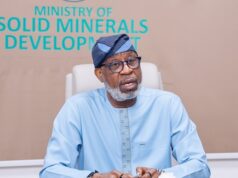







*Prof Aremu
By Shakirudeen Bankole, Lagos
Professor Jonathan Aremu, a Professor of Economics and International Relations and Consultant to ECOWAS on Common Investment Market matters, has challenged African leaders to align their local mineral wealth exploration plans and export policy with the AfCFTA instrument.
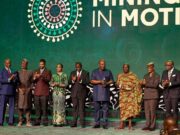
Aremu was speaking while delivering a keynote address at the 4th edition of the Jewelry and Gemstone Conference and Exhibition organised by the Women In Mining Nigeria at the Lagos Oriental Hotel, Lagos, Nigeria.
He spoke on the theme: “Building Global Competitiveness for Africa’s Gold and Gemstones by Leveraging Trade Agreements.”
According to him, there is no gainsaying that the African continent is endowed with vast mineral resources, holding a strategic position in global reserves and production of gold, diamonds and several high-value gemstones.
The African Development Bank (AfDB) confirms that Africa hosts more than 40% of global gold deposits, and accounts for over 60% of world diamond production, with countries such as South Africa, Ghana, Sudan, Mali, Tanzania, Botswana and DR Congo ranking among the top global producers.
Aremu said these reserves have positioned the continent at a strategic place that should be explored for economic and trade wins.
To achieve this expectation, he said effective governance and investment strategies are key.
He explained that the emphasis on “accelerating collaboration” points to the need for African countries to work together by harmonising policies, aligning standards, sharing geological data, coordinating cross-border formalisation, and building regional value chains for cutting, polishing, refining, and marketing.
“This is one of the reasons for the African Economic Community (AEC) Treaty, 1991, with the commencement of its first phase as the African Continental Free Trade Area (AfCFTA),” he said.
Incidentally, Aremu has been at the forefront of campaigning for a unified Africa single market, insisting on the removal of all barriers to aid the African economic prosperity agenda.
He is part of the think tank, from Nigeria, that produced the AfCFTA and is working tirelessly towards its integration and operationalisation across the 12 ECOWAS member states.
Aremu argued that since the gold and gemstone sector is inherently a cross-border business, collective action is required to curb illicit trade, improve traceability, and negotiate better market terms.
The United Nations Economic Commission for Africa (UNECA) had earlier warned that Africa loses over $90 billion annually to illicit financial flows, much of which is linked to under-invoicing of minerals. Aremu noted that curbing this requires a unified regulatory architecture.
He explained that these necessary actions are needed to pool investment for beneficiation hubs under the AfCFTA trade instrument.
Explaining the invaluable worth of gold and gemstones, Aremu stressed that rare earth metals play a significant role in national, regional and global economies, and their impact extends across trade, employment, industrialisation, macroeconomic stability, and international competitiveness.
He said the items account for a major baseline for Government Revenue, as the industry generates substantial fiscal proceeds through royalties, mining taxes, export duties, corporate income tax, licensing fees, and dividends from state-owned mining companies.
The Africa Mining Vision (AMV) notes that minerals contribute more than 10% of total government revenue in several African states, with the figure rising to 70% in resource-dependent economies.
He said the values also extend beyond revenue, stressing further that the sector is responsible for massive employment opportunities and retains the power to transform the livelihood of millions of Africans positively.
“The sectors employ millions of people through artisanal and small-scale miners (ASM), large-scale industrial mining, lapidary workers, cutters, polishers, jewelry designers, and through trades in foreign exchange earnings.
Gold is one of the world’s most traded commodities, and many African economies rely heavily on gold exports for foreign exchange, helping to strengthen currency reserves, support balance of payments, and finance imports of essential goods,” he added.
On gemstones, emeralds, rubies, sapphires, tourmaline,.Aremu also catalogued their invaluable worth and the urgent need to take advantage of them.
The continent holds a prominent position in the global gemstone market, supplying as much as 15–20% of global coloured gemstones, and over 60% of global diamonds. The Southern and Eastern regions dominate high-value deposits: Tanzania (tanzanite), Zambia (emeralds), Mozambique (rubies), Botswana and Namibia (diamonds).
West African nations like Nigeria remain significant producers of tourmaline, aquamarine, sapphire and emeralds across Kaduna, Plateau, Oyo, Nasarawa and Zamfara.
Yet, less than 10% of African gemstones are cut and polished domestically, according to the African Minerals Development Centre (AMDC), which means that the continent loses billions in potential value addition annually.
Despite the low level of beneficiation, Africa’s wealth in these minerals contributes to global supply stability for precious metals and gems; foreign exchange earnings; industrial supply chains in jewelry, electronics, optics and green technologies; local value-added industries such as refineries, cutting and polishing centres, and jewelry manufacturing; investment attraction through improved mining codes; and large-scale job creation, especially in the ASM sector.
Most exports of these minerals remain unrefined or uncut, depriving African economies of job creation, market leverage, and branding power.
The AfCFTA provides what UNECA describes as a “historic opportunity” to create an integrated, competitive and value-added gold and gemstone industry through harmonised regulations, regional value chains, and intra-African investment facilitation.
According to Aremu, beyond revenue attraction, gemstones and gold also have tourism and cultural economic values.
“Both gemstones and gold enhance handicrafts, cultural heritage industries, museum exhibitions, mining tourism and even the ‘mine-to-market’ experience,” he said.