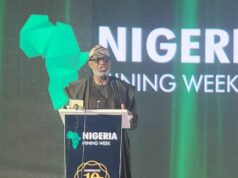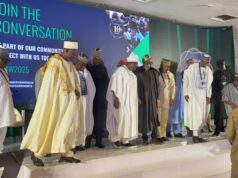


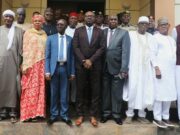
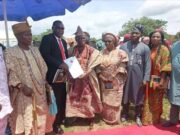

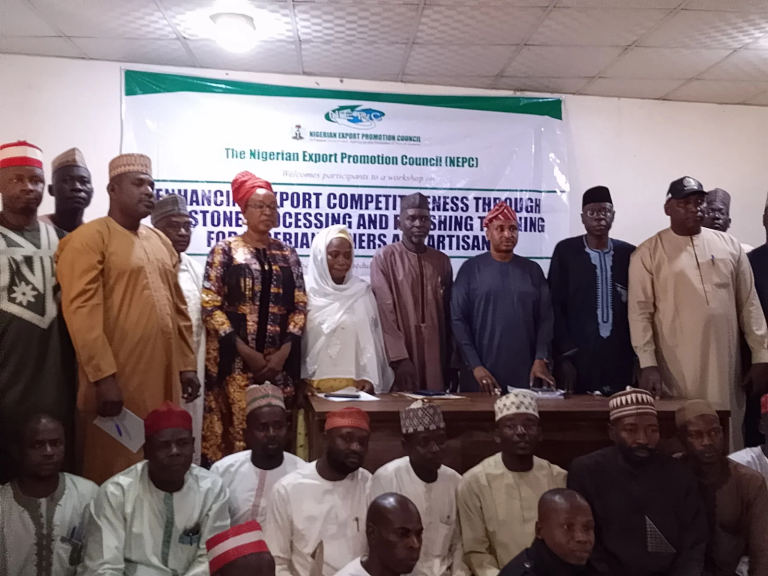

*NEPC officials with a group of Miners at a recent event in Kano
The Nigerian Export Promotion Council (NEPC) has called for an end to the export of raw non-metallic minerals, urging stakeholders to embrace value addition, quality certification and local processing to enable Nigeria compete effectively in the global market and boost non-oil export earnings.
The call was made at a stakeholders’ workshop on “Positioning Nigerian Non-Metallic Minerals for the Global Market” held in Enugu, where government officials, industry experts and exporters explored strategies for unlocking the country’s vast solid minerals potential through beneficiation and industrial processing.
The workshop was declared open by the representative of the permanent secretary, Ministry of Trade, Investment and Industry, Mrs. Tochi Ozulu, who urged participants to take advantage of the engagement to develop practical solutions that would strengthen the solid minerals value chain and attract greater investment to the sector.
In a keynote address, the Executive Director and Chief Executive Officer of the NEPC, Mrs. Nonye Ayeni, said Nigeria could no longer afford to depend on exporting raw minerals if it hoped to maximise the economic potential of the sector.
The ED/CEO, whose address was delivered by the Council’s Southeast Regional Coordinator, Mr. Mustapha Umar Faruk, said, “We cannot double our exports by exporting raw, unprocessed minerals in the same manner we have done for decades. We must add value. We must meet international specifications. We must build the institutional and industrial capacity to process our kaolin, barite, limestone and gypsum into the finished and semi-finished products that the world market demands.”
Ayeni explained that Nigeria is richly endowed with strategic non-metallic minerals, including limestone, gypsum, kaolin, bentonite, phosphate, graphite, marble, sulphur, fluorite and mica, noting that increasing interest from international miners, exporters and investors shows that the sector is fast becoming one of the country’s most promising sources of non-oil export revenue.
She said the council had placed the sector at the centre of its #DoubleYourExport campaign, stressing that expanding Nigeria’s export earnings would require stronger investment in value addition, formalisation of mining activities, processing clusters and export readiness.
Expressing concern over the rejection of Nigerian mineral exports in foreign markets, Ayeni warned that poor quality standards and non-compliance with international specifications continue to cost the country valuable foreign exchange and damage its reputation.
According to her, “We need to significantly reduce the incidence of export rejects experienced by Nigerian solid minerals in foreign markets. We should ensure that our minerals meet global specifications and certification requirements to increase both the volume and value of revenue accruing to the sector.”
She also encouraged stakeholders across Enugu State and the Southeast to embrace the NEPC’s One State One Product (OSOP) initiative, describing it as a practical framework for identifying globally competitive mineral products, strengthening mining cooperatives and expanding access to international markets.
Presenting the first technical paper, Mrs. Chika Okany of the NEPC said Nigeria has more than 44 mineral types across the country, with seven priority non-metallic minerals offering enormous export opportunities due to rising global demand from the construction, ceramics, glass, cosmetics, energy and jewellery industries.
Okany, however, identified the continued export of raw minerals, inadequate processing facilities, weak quality assurance systems, poor documentation, high logistics costs, limited financing and inadequate market intelligence as major constraints limiting Nigeria’s competitiveness.
She recommended increased investment in beneficiation, geological mapping, export certification, financing and stronger collaboration among agencies responsible for export promotion and industrial development.
She disclosed that under the One State One Product (OSOP) initiative, Enugu State has selected coal as its primary export product and limestone as its alternative mineral, while other states are identifying mineral products based on their comparative advantages.
In the second technical presentation, titled “Driving Export Growth through Value Addition in Nigeria’s Non-Metallic Minerals Sector,” Engr. Odel Benjamin, representing the Enugu State Ministry of Solid Minerals Development, said Nigeria could significantly increase export earnings by processing minerals into finished and semi-finished products before export.
He noted that transforming limestone into cement, kaolin into ceramics, silica sand into glass products and gypsum into building materials would create more jobs, strengthen industrial capacity and increase the value of Nigeria’s mineral exports.
He also called for the establishment of beneficiation plants, improved infrastructure, increased private sector investment, technical skills development and stronger international partnerships to reposition Nigeria as a leading exporter of value-added mineral products.
Participants at the workshop agreed that strengthening local processing capacity, enforcing international quality standards and promoting public-private collaboration would not only increase foreign exchange earnings but also accelerate industrialisation, create employment and support Nigeria’s economic diversification agenda.