




By Adesuwa Dan-Princewill
For far too long, our conversations about Nigerian mining has been stuck in a loop of “untapped potential.” Nigeria boasts of a geological tapestry of over 44 minerals, yet the climb from artisanal digging to large-scale, Tier-1 industrial production has been extremely difficult. The real obstacle hasn’t been a lack of minerals, but has been the lack of bankable data and the prohibitive risk that comes with unverified and unquantified mineral reserves.
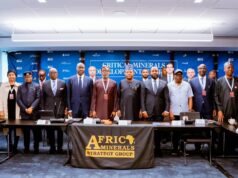
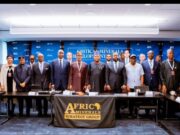
This is why the Memorandum of Understanding (MoU) on Cooperation in the Field of Geology, Mining, and Mineral Processing is so vital and welcome. Signed on April 17, 2025, by the Nigerian Minister of Solid Minerals Development, Dele Alake, and South Africa’s Minister Gwede Mantashe, this agreement can be the strategic bridge Nigeria urgently needs.
The MoU establishes the framework for geological data sharing, high-tech capacity building, and the mineral processing necessary to add real value to our resources.
While the ink dried in 2025, 2026 is the year scheduled to see the “active implementation” phase.
The agreement has officially moved out of the boardroom in Abuja. The launch of the “Intelligent Mapping” Pilot is now front and center, with drone fleets deploying across key corridors to turn historical uncertainty into verified, bankable assets.
Artificial Intelligence (AI) has completely changed the game. These flying cameras have become “Intelligent Explorers” that justify every kobo of investment:
Predictive Modeling: AI algorithms of these drones can now sift through massive amounts of spectral data to find mineral signatures deep underground that the human eye simply cannot see. In the world of modern exploration, spectral data acts as a “digital fingerprint” for the Earth.
By using specialized sensors on drones, mineral compositions across vast terrains can be discovered without moving a single grain of sand. This data provides the objective, scientific proof that international investors require to move a project from a “speculative” curiosity to a “bankable” asset.

Precision Targeting: In the past, remote sensing took months of manual guesswork. Today, AI analyzes anomalies in real-time, meaning investors don’t waste money on “dry” unprofitable boreholes, rather drilling can be done with surgical precision.
Data Interoperability: By working with South African specialists, the NGSA is harmonizing different datasets. This is resulting in a unified, “smart” map of our mineral wealth that updates automatically as new data comes in from the field.
The “Brownfield” Advantage
A major pillar of our 2026 strategy is the focus on Brownfield sites—locations where there is already historical data and proven minerals. This changes our growth trajectory in three massive ways:
Lower Investor Hesitation: These sites are a fast-track to production because the “discovery” work is already documented.
Higher Asset Valuation: A license for a Brownfield site is inherently more valuable. It’s a “Bankable Asset” that our local companies can use to secure serious equity partnerships.
Lower CAPEX: By using existing geological footprints and access roads, the initial cost to get a mine running is significantly lower.
By partnering with South Africa, Nigeria is measuring itself against the SAMREC (Reporting) and SAMVAL (Valuation) standards.
These administrative rules are the gold standard of transparency. When a Nigerian project is reported under these frameworks, it gains instant respect on the Johannesburg, London, and Toronto stock exchanges.
We are shortening a fifty-year learning curve and signaling to the world: Nigeria is no longer a frontier of “speculative rocks,” but a destination for institutional investment.
This industrial shift as per the MOU agreement, is designed to impact the pocket of everyday Nigerians.
High-Value Job Creation: Nigeria is pivoting from a sector historically dominated by manual labor toward a sophisticated, tech-led industrial strategy. The 2026 training hubs are specifically designed to equip Nigerians with future-ready skills, producing a new generation of drone pilots, AI data analysts, and specialized lab technicians.
Capturing “Hidden” Value: AI mapping often finds high-value minerals like Lithium or Tantalite that were ignored and abandoned unknowingly in old gold or tin mines.
The Social Dividend: Faster production means Community Development Agreement (CDA) funds flow into local clinics, schools, and roads much earlier. This strengthens the bond between the miners and their host communities.
From artisan miners to state-owned enterprise, everyone in the industry is required to commit to these new rules of transparency and technical specificity. Nigeria’s mining industry is beginning to follow the same high standards used by global industry leaders.
The MoU ensures that the days of speculation about what “could” be in the ground are finally over. Nigeria has entered an era of certainty and verifiable mineral wealth. Nigeria should stick to these new standards and hit our 2026 goals.
In conclusion, as we move through 2026, the standard for mining in Nigeria is rising. We are now measuring ourselves against the best in the world. The success of our current mapping projects should prove that this MOU agreement is a real catalyst for economic growth.
*Adesuwa Dan-Princewill is CEO of FAR Horizon Minerals