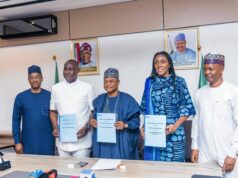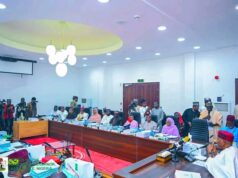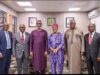



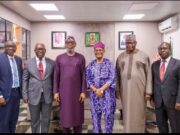


- Dr Alake (seated right) with Secretary General of AMSG Amb. Moses Engandu and other Ministers of Mines
By Laraba Yakubu
Africa holds about 30 per cent of the world’s mineral resources, yet it remains the world’s poorest continent. According to the World Bank, 22 of the 26 countries classified as low-income economies are in Africa, indicating that the continent’s abundant natural resources have yet to translate into broad-based economic prosperity.
Analysts argue that, despite the multiple factors driving poverty, Africa possesses a significant opportunity to reverse this trend by strategically leveraging its solid mineral endowment.
With at least 35 African countries producing one or more critical minerals essential to the global energy transition, the continent occupies a pivotal position that, if effectively harnessed, could support industrialisation, job creation and sustainable local development.
For example the Democratic Republic of Congo (DRC), supplies more than 70 per cent of the global cobalt used in lithium-ion batteries.
Guinea-holds 23 per cent of the world’s largest bauxite reserves , which are used to produce aluminum , a critical metal for solar panels manufacturing and ranks as the world`s second-largest producer.
South Africa possesses about 80 per cent of the world’s platinum group metals (PGMs) reserves, accounting for 91 per cent of global platinum, 46 per cent of yttrium, 22 per cent of manganese, 35 per cent of chromium and 16 per cent of vanadium.
Morocco holds over 50 billion tons of phosphate reserves, representing about 70 per cent of global total phosphate resources, which are crucial for fertiliser production and important for battery technologies.
Zimbabwe has Africa’s largest lithium reserves, estimated at about 11 million tonnes and is the world’s sixth-largest producer.
Gabon has the world’s second-largest manganese deposits, a key component of lithium-ion batteries, particularly for electric vehicles and energy storage systems and is the third-largest producer globally.
Experts say Africa can make commitments that would enable the region to demand value addition to its minerals, most of which are currently exported in raw form, leaving the continent with only a small share of their eventual market value.
According to them, this pattern has created a structural imbalance, with African countries re-importing high-value finished products made from their own raw materials at significantly higher costs.
Prof. Shekwonyadu Iyakwari, an expert in Applied Mineralogy and Exploration Geology at the Federal University of Lafia, noted that many ore deposits in Nigeria contain multiple valuable minerals, yet companies often declare only one or two for export.
“When companies start processing here, we will see that what they are allowed to export goes beyond what is declared. Processing locally will go a long way in helping our economy,” he said.
Civil society groups, such as the Renevlyn Development Initiative (RDI), warn that Africa’s external dependency, described as a “mineral heist”, will persist unless unfair trade structures, weak governance and limited local value addition are urgently addressed.
Similarly, the Nigeria Mining and Geosciences Society (NMGS) renewed calls for stronger resource management and value addition at its 2025 conference as a pathway for Nigeria and Africa to harness critical minerals for development.
Nonetheless, for Africa to realise this ambition, experts say it requires more than political will; it needs concrete political action and a unified voice to push for value addition while marketing its minerals both within the region and in international markets. This underscores the importance of regional cooperation to achieve this feat.
Against this backdrop, on January 9, 2024, on the sidelines of the third Future Minerals Forum in Riyadh, a forum of African ministers in charge of mining and solid minerals was established.
The forum, known as the Africa Minerals Strategy Group (AMSG), began with 16 African countries. Unanimously, the Nigeria`s Minister for Solid Minerals and Development, Dr Dele Alake was elected to lead the group.
The AMSG aims to empower African nations to collectively shape policies and fully benefit from their mineral wealth through harmonised strategies and cooperation.
It aims to provide a united voice for African countries to advance collaboration, safeguard mineral resources, alongside position the region as a key player in the global energy transition and the critical minerals value chain.
This ambition aligned with the theme of the fourth edition of the African Natural Resources and Energy Investment Summit (AFNIS), ‘Harnessing Local Content for Sustainable Development’.
The summit focused on reshaping Africa’s mineral development model, moving the continent away from dependence on raw material exports toward local industrialisation, mineral refining, energy generation and job creation.
As chairman of the AMSG, Alake’s role involved coordinating efforts to give the region a unified voice in promoting mineral value addition, attracting sustainable investment, creating jobs and ensuring that Africa’s mineral wealth delivers tangible socio-economic benefits.
Analysts say the establishing AMSG could strengthen institutional coordination, deepen cross-border cooperation and embed transparency, sustainability and inclusiveness in Africa’s minerals sector.
The Chairman of the AMSG, in one of his engagements, said Africa’s natural resources could underpin sustainable development, but warned that without deliberate policies on mineral value addition, the continent would continue to fall short of its development goals.
Local content, he said, requires Africa to move away from exporting raw materials and instead build factories, refine minerals, generate power locally and create jobs.
Africa, he added, should be developing green industrial zones where gas is converted into fertiliser, limestone into cement and lithium into battery storage.
Kicking off his responsibilities as chairman, he strongly advocated policies for the adoption of mineral value addition across Africa, drawing parallels with Nigeria’s approach.
He said that in Nigeria, investors are required to present clear value-addition plans before being granted operating licences, a move that has expanded opportunities for establishing mineral processing factories.
Indeed, the advocacy gained traction as African mining ministers at the fourth edition of AFNIS said their countries were adopting the policy. The Malawian Minister of Mining, Monica Chang’anamuno, said the country was committed to adding value to its minerals and restructuring its energy sector.
Chang’anamuno said the government had directed that every company operating in the country should allocate a certain percentage of its operations to mineral value addition.
She added that the government is also working to reform the energy sector as part of efforts to improve the ease of doing business for investors.
Kenya’s Minister for Mining, Blue Economy, Shipping and Maritime Affairs, Hassan Joho, said the establishment of more processing companies indicates that the push for value addition is yielding results in Africa.
Analysts say that if this momentum is sustained, the forum could record more achievements and help lift Africa off the poverty ladder.
Building on this progress, at AMSG’s sixth inter-ministerial meeting, African ministers formally adopted the Pan-African Resources Reporting Code (PARC) for sustainable minerals governance.
This move demonstrates a commitment to harmonised resource management across the continent that aligns with global best practices. The PARC is a new continental standard developed to guide how African countries classify, estimate and publicly report mineral and energy resources.
It provides common rules for how mining companies, geologists and engineers report the size, quality and economic viability of mineral deposits.
With growing interest from countries, bringing its current membership to 24, analysts say that at this pace, the group could record more achievements and help lift Africa off the poverty ladder.
Recently, members of the forum re-elected Dr Dele Alake, Nigeria` solid minerals as its chairman at the 2026 Annual General Meeting of the forum, held on the sidelines of the Future Minerals Forum in Riyadh to serve for a two-year term.
Stakeholders say they expect him to use his new tenure to build on previous achievements, fostering partnerships that are fair, transparent and based on mutual respect, where investors honour their commitment to local content and sustainable development.
“We welcome partners, those who see Africa not just as a source of raw materials, but as a destination for innovation, manufacturing, and shared value.
“We seek partnerships that are fair, transparent, and founded on mutual respect. This means joint ventures where African companies and communities have real equity.
“It means insisting on local content policies that foster skills development and supply chain growth. It means securing fair financing so we are not burdened with unsustainable debt, but instead empowered to co-create prosperity, “the AMSG Chairman said.
He added that the broader vision of the AMSG is to ensure that Africa’s mineral infrastructure is strategically designed, responsibly financed and efficiently managed in a rapidly evolving global environment.
The aim is not to discourage investment, but to ensure that it aligns with long-term stability, transparency and shared economic prosperity.
For his reelection, stakeholders say Alake is expected to lead African mining ministers and CEOs of major mining companies in expanding regional mineral testing infrastructure and in advancing the creation of joint industrial corridors and shared processing facilities.
He is also expected to lead efforts to scale up local beneficiation and reduce export dependency. During his about three years in office as Nigeria’s Solid Minerals Minister, the sector’s revenue rose from a modest N16 billion in 2023 to N70 billion.
This growth was driven by reforms he introduced, including the Value Addition of Minerals Policy and the “use-it-or-lose-it” principle for mineral title licences.
Other measures include a two-pronged approach combining coercive and persuasive strategies to curb illegal mining and secure mining sites nationwide, as well as the introduction of a new mining rate regime.
Analysts expect him to extend this commitment in his second tenure as chairman of AMSG, applying innovations and reforms that successfully bolstered Nigeria’s revenue to guide member countries in achieving similar results and more.
They say that, after laying its foundation in the first two years, AMSG’s leadership is expected to deliver tangible results in the next two, driving regional cooperation for sustainable, transparent, and value-added mineral development.
This is to boost economic growth, secure supply chains and support Africa’s energy transition. Stakeholders expect Alake to encourage more countries to join the forum, which currently has 24 of the 54 African nations as members.
They also expect him to push for the tackling of key sector challenges, including weak governance, regulatory gaps, inadequate geological data and infrastructure deficits.
They highlight other Africa-specific issues, including illegal and artisanal mining, environmental degradation, social conflict, skills and technology gaps and revenue leakages.
Analysts say the leadership of AMSG is expected to mobilise shared knowledge, peer review, and strategic partnerships to tackle sector challenges. They also expect the group to support capacity building and technical training, harmonise mining policies across member states and promote data sharing and transparency.
Facilitating responsible investment, addressing social conflicts, advancing environmental sustainability and encouraging technology adoption are also seen as key priorities for the leadership.
Analysts add that improving revenue tracking, establishing regional mineral processing hubs and advocating Africa’s interests in global mineral markets could further strengthen the continent’s minerals sector and enhance its socio-economic impact.
The forum resolved that the leadership positions be equitably distributed across Africa’s sub-regions to promote inclusion and regional balance. The offices of Chairman and Vice-Chairman would remain elective and reserved for serving ministers.