


*The Mining Marshals team, one of the results of the reforms in the sector, has brought reassurance to mining communities
By Kayode Ogunbunmi
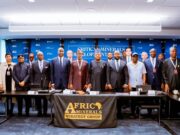
Last week, from July 15-17, Nigeria was the focus of the global mining industry as the Federal Capital Territory played host to the African Natural Resource and Energy Investment Summit (AFNIS) 2025. Present at the event were ministers and private sector players from several Africa, European and Asian nations.
The event, among other things, witnesses the launch of the African Fund and Nigeria’s assent to the Charter of the Africa Minerals Strategy Group (AMSG), which was signed on behalf of the federal government by the Minister of Solid Minerals Dr Dele Alake.
AMSG is an initiative to foster cooperation in the sustainable and transparent development of Africa’s mineral resources, promote exploration, extraction, local beneficiation, and commercialization of minerals, ensuring a secure and sustainable supply chain while driving socio-economic transformation and supporting Africa’s energy transition.
Both the assent to the AMSG charter and the launch of the Africa Fund were part of recent initiatives to make Africans benefit more from the abundance of minerals on the continent.
The clearest evidence of the reforms introduced by the leadership of the Nigerian Solid Minerals ministry is in Nigeria’s lithium and battery value chain, highlighted by Dele Alake at the event. A little over $800 million in mining investments were secured by Nigeria in 2024 alone, following a major policy shift requiring all mining licences to include local processing plans.
The Nasarawa lithium battery plant, valued at $100 million, is already up and running. A $600 million lithium refinery near the Kaduna–Niger border is on the way.
Participants at AFNIS were also taken on tour of a multimillion dollar factory about to take off within the FCT.
Adamu Husaining, president of Absa and Wisdom Group, owners of the plant, told amazed guests that the plant has more than 512 cadastral units, with no fewer than 40 tunnels.
Hussaini said the company was formerly exporting its raw materials to China, but with the value addition policy of the Federal Government, it has transitioned to processing lithium to Electric vehicle (EV) batteries.
Speaking on behalf of visitors, Hassan Joho, Kenya’s Minister for Mining and Blue Economy, described the plant as a proof of Nigeria’s determination to put its mineral value chain plans into concrete action.
It is clear that the reform is not only opening new employment opportunities for Nigerians, it is also ensuring that government revenue from mining is on the upswing. This surged from ₦6 billion in 2023 to ₦38 billion in 2024 — a six-fold increase credited to tighter licensing, enforcement of value-addition rules, and new industrial investments.
This effect is not lost on Nigeria’s guests at the AFNIS event. Liberian official, Jake Kabakole, described Nigeria’s local content regime as a “continental model,” urging African nations to adapt its legal and institutional frameworks to unlock similar outcomes.
It is therefore shocking (or maybe not) that while the nation was celebrated on a global stage – and the glow was yet to wear off – an article written by someone obviously uncomfortable with the successes in the sector was quietly circulated at the weekend.
The article, titled: Mining Cadastre Office: A Threat to National Security, bear the name of Engr. Biliyaminu Surajo as its author.
Of course, as is to be expected of an agenda-laced writing such as this, the writer stated that his purpose was to ensure that Nigeria’s mining sector “cannot afford to continue operating under a system characterized by corruption, inefficiency, and international embarrassment.”
But he then went ahead to argue for the this very same scenario of opacity and inefficiency in a wide ranging attack on the very reforms that has sanitized the sector and the agencies of government implementing the reform process.
The article is a good example of scattering mud around in the hope that some will stick to a part of a structure. It was a wild victory of grievances over substance.
While the writer professed to seek transparency in the licensing regime, he strangely advocated that government scrap the digitalised system and return to manual processing that was discarded years ago for exactly the reasons of lack of transparency, inefficiencies, waste of time, loss of records and… you guessed it… glaring loopholes for sharp practices and corruption.
Strange that someone who claim to want a better mining industry would have disdain for a digitalised system.
Perhaps it is understandable that the writer is unhappy with the recent increase in licensing fees payable to government. Many operators would rather pay less than more, even though this lack of reinvestable funds is one of the factors that has made the sector unable to realise its potentials for so long. It was also the reason why some title holders sat on their licenses for years without developing their sites, as they shop around for whom to offload them onto for fat profits.
But the writer did not stop at this. It was clear that though the MCO might have been the declared focus of the diatribe, this was merely a decoy. The unhappiness is directed at the entire leadership of the Ministry of Solid Ninerals Development and the forward-looking reforms they are promoting. He was unhappy with Nigeria’s trade missions abroad and the resultant influx of new investors into the sector – especially Chinese ones whom he said are using old technologies. It would have been helpful if the writer had shared the identities of those using modern tech and their successes before the advent of the new investors that he did not like.
One of the sessions at the recent AFNIS focused on perception management and the effect of negative narratives on the sector – especially when such a narrative is based on half truths and assumptions.
Engr Surajo’s article is a clear disservice to the sector he professed to love. What the sector needs are clear-headed, factual and problem – solving interventions, rather than scaremongering hypes. We can all do better.
*Ogunbunmi is the Editor-in-Chief of The Miners magazine and The Miners Online (theminers.com.ng)