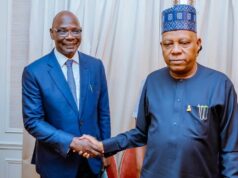


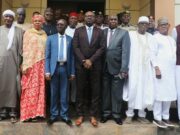
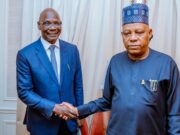



*Photo L-R: Minister of Solid Minerals Development, Dr Dele Alake and Director General of Mining Cadastre Office, Engr Obadiah Simon Nkom*
Introduction

The mining sector, in 2025, was pivotal as Nigeria continues its push towards economic diversification away from oil dependency.
The industry recorded a robust 4.61% growth in the second quarter of the year, contributing 4.6% to the nation’s GDP—a significant leap from less than 0.5% a decade ago.

This surge was fueled by a combination of strategic reforms, global market demands, and technological innovations.
Revenue from the sector reached ₦6.95 billion in the first quarter alone, with 867 new mining licenses issued to bolster operations.
Key minerals such as gold, lithium, barite, tin, rare earth elements, iron ore, lead, zinc, gemstones, and bitumen are at the forefront, driving job creation, rural development, and export growth.
In this article, we explore the major drivers propelling this expansion, drawing on recent developments and projections for sustained momentum.
Government Policies and Reforms
One of the primary catalysts for growth in Nigeria’s mining industry in 2025 has been a series of deliberate government reforms under the Renewed Hope Agenda. These include enhanced transparency in licensing, investment de-risking, and the enforcement of a ‘Use It or Lose It’ clause, which has led to the revocation of dormant licenses to make way for committed investors.
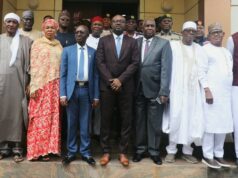
The reform of the Mining Cadastre Office (MCO)has also significantly streamlined processes. The MCO is now fully modernized, following the unveiling of its One-Gov Cloud digitisation project, by the Minister of Solid Minerals Development, Dr Dele Alake.
At the event held mid-December, the Minister highly commended Engr. Obadiah Simon Nkom, the Director General of MCO for successfully leading it to become the first agency under the ministry to fully deploy the federal government’s OneGov Enterprise Content Management System (ECMS).
ECMS is a cloud-based digital platform transforming government operations by digitizing records, automating workflows, and eliminating paper.
Also of significance in the growth of the Nigerian Mining Industry in 2025
was the launch of a new Solid Minerals Development Roadmap which emphasizes beneficiation, infrastructure, and local content.
Additionally, the deployment of over 2,000 Mining Marshals, satellite surveillance systems, and a Minerals Pre-Shipment Agency has curbed illegal mining and ensured revenue assurance.
Community Development
Agreement (CDA) guidelines further promote sustainable practices and local benefits, fostering investor confidence and positioning the sector as a key pillar for economic transformation.
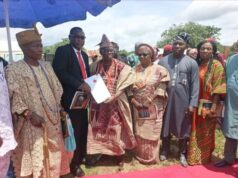
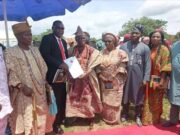
Among the latest of the CDA guidelines implementation was a five-year, multi-million naira Community Development Agreement (CDA) between Century Mining Company (CMC) and Riruwai Community in Doguwa Local Government Area of Kano State signed late December.

*L-R: Gov Abba Kabir Yusuf of Kano State and Hon Hamza Safiyanu Kachako, Kano State Commissioner for Mineral Resources*
The agreement, supervised by Kano State Ministry of Mineral Resources and approved by the Federal Ministry of Solid Minerals Development, will run from 2026 to 2030 and is expected to deliver wide-ranging socio-economic benefits to the host community where CMC operates mining activities involving tin, zinc and other related minerals.
CMC has good lessons to learn from Segilola Resources Operating Limited (SROL) in this respect.
SROL has a record of strong adherence to its Community Development Agreements (CDAs) with its three host communities: Iperindo, Odo Ijesha, and Imogbara. Both the company’s self-reports and external government fact-finding missions indicate that SROL is implementing numerous projects as part of its commitments.
The company is implementing various initiatives across several key areas as part of its CDA and Corporate Social Responsibility (CSR) efforts. These include Education and Youth Empowerment; Healthcare Initiatives; Infrastructure Development and Sustainable Livelihood Programs.
The policies and innovations by the Federal Government
have not only increased the number of operational mines but also attracted serious players, contributing to higher royalties and exports. For instance, rising royalties from gold mining are expected to significantly boost non-oil GDP contributions over the next five years.
Investment and Funding Opportunities
Growing investments, both domestic and foreign, represent another critical driver. Nigeria’s vast mineral reserves align with global demands, particularly for clean energy technologies, leading to elevated prices for commodities like lithium and cobalt.
The government has introduced incentives for local beneficiation projects and strengthened the Solid Minerals Development Fund to support exploration and value addition.
This has opened doors for opportunities in gold mining, lithium extraction for batteries, gemstone trade, and industrial minerals like limestone and gypsum, which support construction and manufacturing.
Allied sectors such as logistics, equipment supply, and environmental consulting are also seeing influxes, with the mining machinery market expanding due to rising mineral demand.
These investments are projected to enhance rural development, infrastructure, and job creation, reducing oil reliance and stimulating broader economic unity.
Technological Advancements and Innovation
The adoption of modern technologies has revolutionized efficiency and sustainability in the sector. Artificial Intelligence (AI), Internet of Things (IoT), and blockchain are being integrated for better exploration, predictive maintenance, safety monitoring, and supply chain management.
Tools like the Nigerian Mineral Resources Decision Support System aid in geological mapping and data digitization, while Compressed Natural Gas (CNG) for power generation reduces costs and emissions.
This tech-driven approach minimizes risks, optimizes recovery rates, and supports progressive rehabilitation, aligning with global Environmental, Social, and Governance (ESG) standards.
As a result, operations are more competitive, attracting tech-savvy investors and enabling the sector to meet international demands for responsibly sourced minerals.
Multi-Pillar Expansion Strategy
At the African Mining Week (AMW) 2025, Nigeria unveiled a comprehensive multi-pillar strategy to shift from raw exports to value-added production, unlocking mineral wealth and promoting industrialization.
The four pillars include:
Beneficiation and Value Addition: Establishing processing plants for rare earths and promoting regional infrastructure to create value chains.
Energy Infrastructure Development: Ensuring reliable power and leveraging the African Continental Free Trade Area (AfCFTA) for market integration.
Technology Transfer and Skills Development: Empowering youth through training for sustainable practices.
Policy and Investment Alignment: Harmonizing regulations and partnerships across Africa.
This framework drives growth by fostering regional collaboration, job opportunities, and sustainable resource utilization, with a focus on critical minerals for green transitions.
Global Demand and Market Dynamics
Rising global demand for minerals essential to clean energy—such as lithium for electric vehicle batteries and rare earths for renewables—has positioned Nigeria favorably.
Stable gold prices and the sector’s role in bullion processing further enhance export potential, supporting rural economies and infrastructure links with agriculture.
Conclusion
The Nigerian mining industry’s growth in 2025 is a testament to strategic foresight, with drivers like policy reforms, investments, technology, and global demand converging to elevate its GDP role and create lasting economic impacts. Projections indicate continued expansion, potentially surpassing current targets if reforms are sustained.
By prioritizing sustainability and value addition, Nigeria is not only diversifying its economy but also positioning itself as a key player in Africa’s mining landscape.