




*Menegbo
Segilola Resources Operating Limited (SROL), a subsidiary of Thor Explorations Ltd., operates Nigeria’s first commercial gold mine, the Segilola Gold Mine in Osun State, which commenced commercial production in 2022.
The mine produced 98,006 ounces of gold in its first year and 84,609 ounces in 2023, showcasing consistent performance.
In 2024, SROL was recognized by the Nigerian Export Promotion Council (NEPC) as one of Nigeria’s top 10 non-oil exporters, highlighting its leading role in the nation’s economic diversification project.
The company employs over 95% Nigerian staff, many of them from host communities, thereby fostering local economic growth.
SROL has signed Community Development Agreements (CDAs) with its host communities, promoting sustainable development through initiatives like environmental sustainability and local projects.
The company implements world-class environmental monitoring, audited by independent third-party consultants, to prevent pollution and ensure compliance with regulations from the Federal Ministry of Solid Minerals Development and the Federal Ministry of Environment.
SROL equally promotes sustainable mining practices and engages in community enrichment programs, including a 2025 university competition for Osun State students to propose solutions to illegal mining, offering up to ₦500,000 in prizes.
Despite all these, SROL is not without its troubling moments. In September 2024, for example, the Osun State Government sealed its premises following a court order over alleged tax evasion, failure to disclose employee details, and obstruction of tax processes from 2019 to 2023. It took the intervention of the Nigerian Minister of Solid Minerals Development, Dr Dele Alake, before a truce was achieved between the State Government and SROL.
In this interview with TheMiners editors, Mr Austin Menegbo, the Country Manager of SROL, speaks on a wide range of issues relating to the company’s relentless growth. Excerpts:
As an operator of Nigeria’s first and only large-scale gold mining interest, can you tell us what led you to take this route, and not the easy part of unregularised mining that others seem to prefer?
For us, taking the formal, fully regulated route was never up for debate; it was the only path we considered. From the onset, our vision was clear: to build a world-class gold mining operation that would set a new benchmark for how mining should be done in Nigeria.
The fact that no one had done it on a large scale, legally, wasn’t a deterrent—it was a motivator. We saw an opportunity not just to mine gold, but to demonstrate that responsible, transparent, and sustainable mining is not only possible in Nigeria, but essential for the sector’s long-term success.
Choosing the path of legality could also be problematic, with different agencies coming at you. Have you ever had regrets about this?
Not once. As I’ve mentioned, operating illegally was never an option for us. Yes, navigating the regulatory landscape in a developing industry comes with its fair share of challenges. Coordinating with multiple agencies and ensuring full compliance requires patience, persistence, and a strong sense of purpose. But every challenge we’ve faced has made us stronger and more resilient as an organization.
We’ve learned, adapted, and, most importantly, built trust—trust with regulators, communities, and other stakeholders. That trust is one of our most valuable assets today. We believe that long-term success in mining can only be built on a solid foundation of transparency, legality, and respect for the rule of law.
Nigeria is known to be a tough operating environment. What were the challenges you had starting out and how did you resolve and overcome them?
Nigeria’s mining industry has immense potential, but being the first mover came with its share of challenges. For us, these were less about the operating environment and more about pioneering in a sector that was still finding its feet after years of artisanal/illegal activity and underinvestment.
One of our earliest hurdles was securing the capital needed to bring the Segilola Gold Project to life. As the first large-scale commercial gold mine in the country, there was limited precedent to give investors confidence. We had to build that credibility from the ground up.
Another challenge was the scarcity of reliable geological data. We were somewhat fortunate that previous owners had made valuable exploration investments, but even then, we had to invest heavily in further technical studies to de-risk the project.
Talent was also a major consideration. With Nigeria’s mining sector still in its infancy, finding local professionals with deep mining expertise wasn’t always easy. That challenge became an opportunity—we committed to building local capacity, developing the workforce, and nurturing mining competencies in-country. Where immediate expertise wasn’t available, we turned to Nigeria’s well-established Oil and Gas sector, bringing in professionals whose skills in areas like HSE, project management, finance, and HR translated seamlessly into mining operations.
In the end, these challenges shaped our approach: resilient, adaptive, and deeply committed to sustainable, local-led growth in Nigeria’s solid minerals industry.
Your company has consistently been a major sponsor of many mining exhibitions and other related events in country. What is the motivation behind this and which message are you trying to pass across by this?
We recognize the significance of our role in shaping the future of the country’s solid minerals sector. Our consistent sponsorship of mining exhibitions and industry events reflects our commitment to driving awareness, collaboration, and innovation across the mining value chain.
Our motivation is two-fold: first, to showcase the work that we are doing; and second, to showcase the country as a viable and attractive gold mining jurisdiction to both local and international stakeholders.
Through our presence at these events, we continue to reinforce key messages that define who we are—our dedication to operational excellence, our unwavering commitment to responsible and ethical mining practices, sustainability, and the strength of our social license to operate.
How committed are you to local content and capacity building in both internal and external operations?
At the Segilola Gold Mine, we’re proud to say that 99% of our workforce is Nigerian. That statistic isn’t by accident. It’s the result of intentional investment in training, skills development, and long-term career growth. For the small number of expatriates we do have, we ensure structured knowledge transfer and on-the-job mentorship, so that expertise is continuously passed on to local talent.
Beyond our gates, we are deeply committed to uplifting our host communities. Through initiatives like the Youth Empowerment Programme and the Segilola Women’s Initiative Programme, we’re equipping people with practical skills and tools to thrive. Our investment in education is also a key focus—we provide scholarships and support learning at every level because we believe education is the foundation of sustainable development.

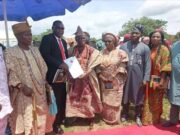
*During the commissioning of a community infrastructure built by Segilola
Your relationship with your host communities is often a reference in the industry on how things should be done. How have you been able to win and sustain the trust of communities where your mine assets are located?
Our strong relationship with host communities is built on a foundation of inclusion, integrity, and cultural respect—and we’re proud that it’s often cited as an industry benchmark.
First, we ensure that all voices within the community are heard, especially those that are often marginalized—women, youth, and vulnerable groups. By involving them in the Community Development Agreement (CDA) committee and its decision-making processes, we foster a sense of ownership and inclusion.
Second, we keep our word. Trust is earned through consistency, and we’ve made it a priority to follow through on every commitment we make. Whether it’s employment, infrastructure, education, or social investments, we understand that credibility is built action by action.
Lastly, we recognized early on the vital role of traditional leaders and respected elders in community affairs. We embraced what we call cultural governance—the deliberate and respectful inclusion of traditional leadership in our engagement strategy. Their guidance, influence, and deep connection with the community have been instrumental in fostering mutual respect and long-term collaboration.
This approach has not only enabled us to earn trust, but also to sustain it over time.

What other projects are we expecting from Segilola/Thor Explorations?
At Segilola, growth and discovery remain at the heart of our strategy. We’re actively advancing near-mine exploration around the Segilola Gold Mine, with the goal of extending the mine life and maximizing long-term value. In parallel, we’re pursuing a broader exploration program in Nigeria to unlock new commercial gold deposits and further demonstrate the country’s potential as a viable and exciting mining jurisdiction.
What do you do with your time if you are not occupied with Segilola affairs?
When I’m not immersed in Segilola affairs, I spend my time staying active and intellectually engaged. I’m a passionate football enthusiast—both as a player and a fan—and I also enjoy swimming as a way to unwind and recharge. Beyond the physical, I dedicate time to studying and staying informed on emerging trends in artificial intelligence and business ethics. These areas not only interest me personally but also help broaden my perspective as a business leader navigating an increasingly dynamic and tech-driven world
Your community development efforts have earned praise both within and outside the industry. Can you share a specific example that best illustrates the impact of your work on your host communities?
Definitely. One of our most impactful initiatives to date is the Livelihood Restoration Programs (LRP), designed specifically for project-affected persons (PAPs) across our host communities. Beyond fulfilling compensation requirements, we felt a responsibility to ensure that affected individuals and families could transition into sustainable livelihoods. The LRP includes the establishment of a fish market, a vegetable garden, and a cocoa rehabilitation program, based on detailed needs assessments and socio-economic studies.
In practical terms, we constructed and equipped 100 fishponds, provided juvenile fish, supplied eight months’ worth of fish feed, and introduced a fish smoking machine to add value to their produce. I should mention that I personally patronize them for smoked fish—and I can confidently say, it’s delicious! For those in the vegetable farming program, we delivered agricultural equipment, irrigation systems, seedlings, and agrochemicals including herbicides, fungicides, and fertilizers. On the cocoa rehabilitation, each PAP received improved yield seedlings, a season’s supply of agricultural inputs, and sprayers to support effective farm management. We’re also planning to expand the program to include palm oil rehabilitation later this year.
What sets the LRP apart is that it goes beyond infrastructure—it’s about true empowerment. PAPs have been organized into formal cooperatives, registered with the state ministry, trained in both agricultural techniques and business practices, and supported to open bank accounts. We’re not just handing out tools; we’re laying a foundation for lasting economic independence.
Another initiative that’s particularly close to my heart is the Segilola Football Tournament (SFT). As a football enthusiast myself, I’ve seen first-hand how powerful sports can be in bridging divides. The tournament isn’t just a game—it’s a platform for connection. Community members and SROL staff play side by side, strengthening relationships in ways that formal engagement sometimes can’t. It reinforces the idea that we are not just operating in these communities—we are part of them.
You’ve been with the Segilola Gold Project for several years now. Can you share what this journey has meant to you personally and professionally?
Absolutely. Being part of the Segilola Gold Project from its early stages has been both a tremendous responsibility and a deeply rewarding experience. When I joined the project, Nigeria’s legal mining landscape was largely uncharted territory, and we were building something without a local playbook. It meant pioneering not just the technical and operational aspects, but also shaping how mining could coexist respectfully and sustainably with host communities.
Over the years, my role has evolved—from setting up foundational systems to now overseeing our government relations, exports, and corporate affairs. But what has remained constant is the privilege of working alongside an incredibly resilient team and engaging with communities whose trust we’ve earned through transparency and shared value.
This project has tested and strengthened me in every way—as a leader, a negotiator, a problem-solver, and most importantly, as a partner to the people and places we work in. It’s been a journey of growth for the company and for me personally.