






*Akapo
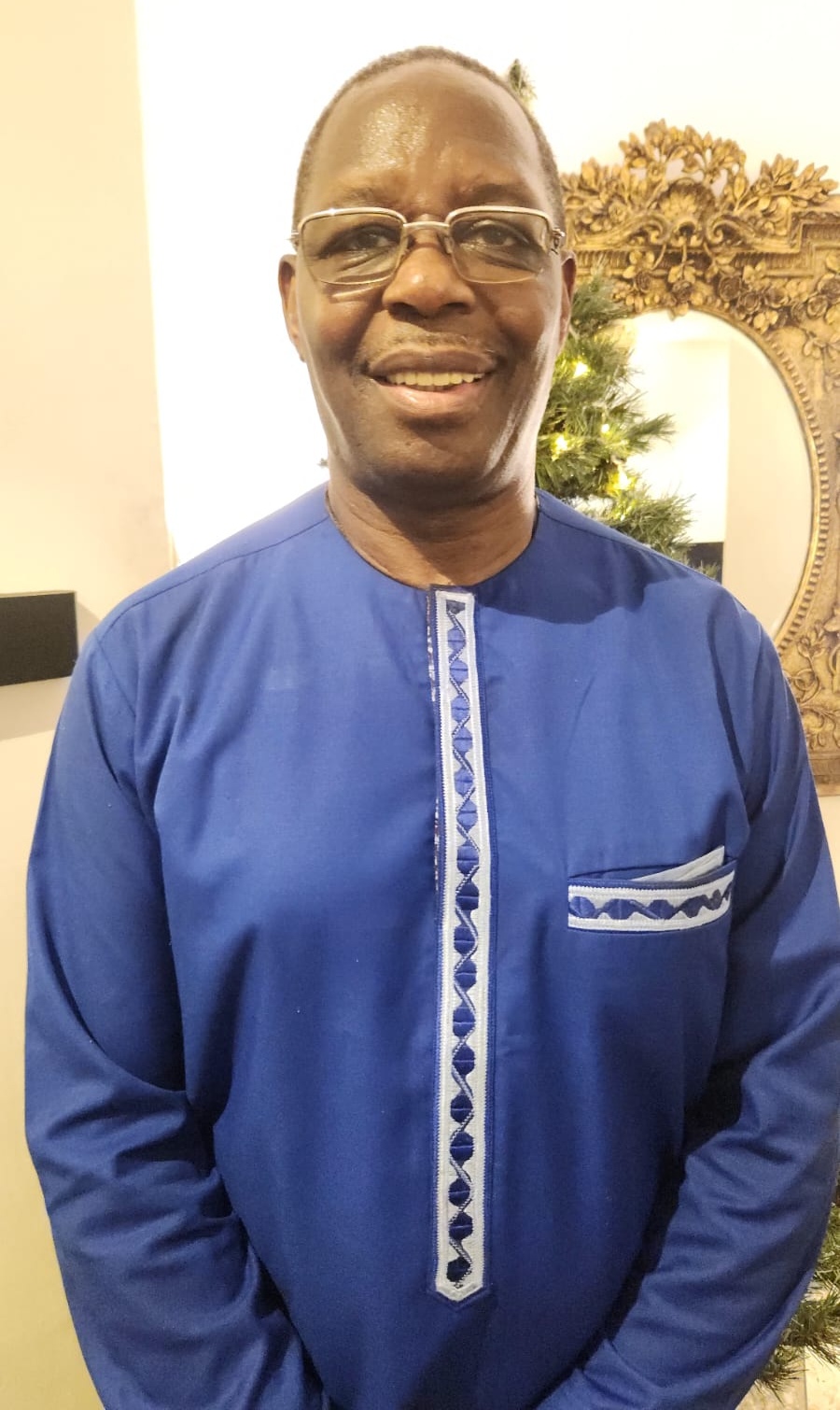
For nearly five decades, master goldsmith and diamond mounter, Thomas Owolabi Akapo, popularly known as Mr. Kapo, has worked at the highest levels of the global jewellery industry, from London’s elite workshops to structured skills-transfer programmes in Southern Africa. Trained through discipline and tenacity – synonymous with the transformation of the precious stone itself from its raw form to finished product of luxury, Akapo’s career reflects the quiet persistence of African expertise long excluded from formal systems.
In this wide-ranging interview on the sidelines of the 2025 Gold and Gemstones Exhibition and Conference, Akapo links jewellery making to mathematics, ancient African knowledge systems, and modern skills policy, arguing that Africa’s mineral wealth will remain incomplete without deliberate investment in mastery, mentorship, and structured skills development. Excerpts:
By Shakirudeen Bankole
Q: Kindly introduce yourself?
A: My name is Thomas Owolabi Akapo. Originally, our family name was Akapo, but when my family travelled to London, my father removed the “A”, and my brothers, sisters, and I became known as Kapo. Interestingly, my cousins here in Nigeria are still Akapo. I have been in the jewellery industry for close to five decades. By next year, it will be 50 years. I describe myself as a goldsmith, but in the United Kingdom the formal trade name is diamond mounter. A diamond mounter is the person who makes the mount that supports diamonds and gemstones.
In the UK trade listings, if you were looking for employment, you would not find us under goldsmiths. You would find us listed as diamond mounters, often in the same column as architects, doctors, and lawyers. It is regarded as a serious professional qualification. Typically, it involves a five-year apprenticeship, followed by another two years as what is called an “improver”, before you are recognised as fully qualified.
Q: How does one obtain certification in this field?
A: There is a formal trade test through recognised institutions. However, despite having worked for major auction houses such as Sotheby’s, Christie’s, and Phillips —institutions whose works circulate globally— I did not take that certification early in my career.
At the time, discrimination in London was a major factor. Even after 28 years of professional practice, my work was everywhere, yet I did not hold a formal certificate stating that I was a goldsmith or diamond mounter. Ironically, I was already training others.
Some of those I trained were South Africans —specifically white South African goldsmiths— who had left South Africa during the apartheid era. Under the apartheid government, immigrants who were not born in South Africa were required to do national military service. Many did not want that. Some married British citizens; others claimed UK ancestry and left the country. Several of them ended up working in the London workshops where I was employed, and I trained about four or five of them over time.
Q: How did your journey into jewellery making begin?
A: It began largely by chance. A friend of mine, Bernard Bologna, who was of Italian descent, worked in a jewellery shop in Knightsbridge, London. I often visited him after work. One day, while looking at the shop window, I saw a watch that I could not afford as a one-off payment. At the time, I was studying engineering. I asked Bernard if he could speak to his employer to allow me to pay weekly. In those days, we were paid weekly, not monthly.
His employers, Mr. and Mrs. Pira, agreed. I took the watch and paid weekly. When I went to make my final payment, Bernard was not around, and the shop was short of staff. They asked if I could help for two weeks until they found someone else. I agreed. After two weeks, they asked if I wanted a permanent job. I thought about it and accepted. That was my entry into the jewellery industry.
At the beginning, the work was very rudimentary. We worked with materials such as coral, ivory, tortoiseshell, and elephant hair. Many of these materials were later banned due to poaching and concerns about endangered species. But that was how I learned the early foundations of the craft.
Q: When did you realise you needed deeper training?
A: As time went on, I realised I needed to know more. I would look at the rings in the shop windows and cabinets and ask myself, how are these made? My employer at the time was not teaching at that level.
I requested permission to attend a college. Eventually, they agreed, but the condition was that I would work on Saturdays to cover the day I attended classes. I enrolled at the John Cass Jewellery School in Aldgate East, London, attending one day a week.
The teachers there were practising goldsmiths who had worked in the industry. That was very important. In some places I later worked in Africa, the best student would simply become the teacher of the next generation, even without industry exposure. That creates serious knowledge gaps.
At John Cass, we started from very basic tools. There were no electric drills. We used bow drills operated by string. It was rudimentary, but it grounded you properly in the craft.
Q: How did you transition to high-end jewellery and diamond mounting?
A: There was no single moment of mastery. I was learning and working simultaneously. I did not complete a formal apprenticeship. I knew that where I started in Knightsbridge, I would not learn high-end diamond mounting. The owners were Asians from Tanzania, and the jewellery style was largely African and traditional.
To learn high-end work, I had to enter Hatton Garden, the heart of London’s jewellery industry. It was not easy. There were very few opportunities for Black people, and I was not in a recognised apprenticeship.
Eventually, I found work with Mr. Barry Stern, whose father was also a skilled goldsmith. He took me on as a trainee but required me to work five days a week. I had to leave the John Cass Jewellery School unfinished. That decision shaped my career.
Q: How did your background in engineering and mathematics influence your mastery?
A: It helped immensely. I was good at mathematics and geometry—what we used to call technical drawing at school. Jewellery making, especially at a high level, is deeply mathematical. For example, if you are making a wedding ring and the diameter is 17 millimetres, you need to know the exact length of metal required before you bend it into a circle. You multiply the diameter by pi, 3.142. Gold is expensive; you cannot waste even a small amount. I teach young jewellers today by reconnecting them to mathematics they learned in school, especially Pythagoras. Once they understand that relationship between flat measurements and circular forms, the work becomes easier.
Q: You emphasise tools, precision, and patience. Why are these important?
A: Tools are essential, and in our industry, they are perishables. Saw blades break. Drills wear out. Burs must be replaced regularly. Rolling mills, for instance, help turn metal into square wire before flattening it. If you want to make a six-millimetre wedding band, you might first create a four-millimetre square wire. When flattened correctly, it spreads into six millimetres. These are things you only learn through years of experience. Patience, focus, and discipline are critical.
Q: Can you explain gold purity and assaying?
A: Beyond the London Assay Office method, there is water displacement. You weigh the gold in air, then suspend it in water and weigh it again. Using equations, you determine the caratage.
Twenty-two-carat gold is 92 percent pure. Eighteen-carat gold is 75 percent pure, stamped as 750. The remaining percentage is copper and silver. Adjusting those ratios changes the colour of the gold. These are scientific and mathematical principles, not guesswork.
Gold is currently over four thousand dollars per ounce. A gold ounce, called a Troy ounce, is 31.1 grams. That measurement is ancient, and Africans were using equivalent systems long before European standardisation.
Q: What did you observe during your early engagements with Nigeria?
A: I first returned to Nigeria in December 1986, when I was 26 years old. I stayed in Ikeja and later travelled to Jos. I discovered that Nigeria had emeralds, sapphires, rubies, aquamarine, tourmaline, and gold.
However, there was no structured access to gold for small-scale jewellers. In London, I could buy twelve grams of gold to make a ten-gram wedding band. In Nigeria, I could not do that. Tools were also unavailable. I explored Ghana, Gambia, and Tunisia. Ghana was better organised. Gambia had tourism potential. My idea was to manufacture in Africa and sell to European tourists using London assay marks.
Q: Why did South Africa become a turning point?
A: South Africa had a government-backed Learnership Programme, created to address skills denied during apartheid. The government paid students’ transport and stipends while they learned. When I began teaching there, I realised my skills exceeded many European counterparts. Some deliberately limited what they taught Africans to protect their market dominance. I did not do that. In 2003, my wife and I opened our company and began transferring skills at a high level. We became one of the first Black-owned companies in South Africa offering advanced jewellery skills training.
Q:Did that experience influence your desire to return to Nigeria?
A: Yes, very strongly. Africa cannot rely on partial skill transfer. Knowledge must be shared fully. For a long time, people did not understand the depth of skill I was bringing. I was always ready to return home, but the environment was not prepared. Now, with Nigeria reopening the solid minerals sector, the timing is better.
Q: How can jewellery skills be scaled in Nigeria?
A: There are no shortcuts. Jewellery mastery takes time. But with structured programmes—three months, six months, and long-term mentorship—it is possible.
What is required is serious commitment: tools, materials, patience, and investment in people. That is how true industrial capacity is built.