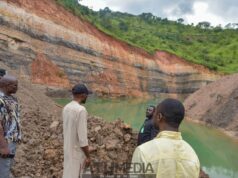




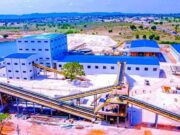

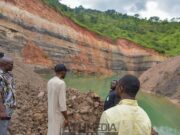
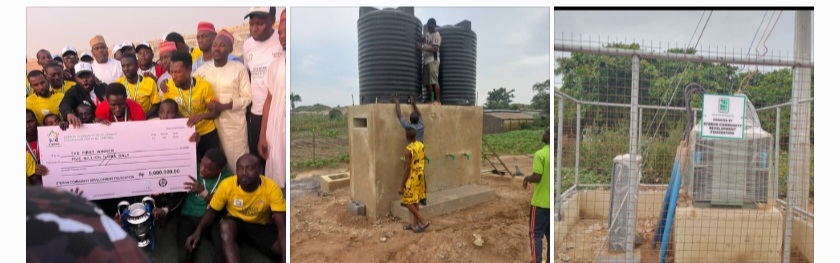
Mining companies are building schools, clinics, roads and water projects in communities sitting on Nigeria’s mineral wealth. But beneath the photographs of commissioned projects is a harder question: are these interventions transforming host communities—or merely buying social acceptance for extraction?

The signboard is impressive.
It carries the name of the mining company, the date of commissioning and a message about partnership with the community. Nearby may stand a freshly painted classroom block, a borehole, a health centre or a stretch of newly constructed road.

For the visiting dignitary, it is a development success story.
For the people who live there, however, the picture can be considerably more complicated.
A road may have opened access to a village but still be unusable during the rainy season. A water project may have been commissioned but stopped functioning months later. A school may have been built without enough teachers. A community may have signed a Community Development Agreement (CDA), yet many residents may not know what the agreement contains or what they are entitled to demand.
And beneath all of this is the central question confronting Nigeria’s rapidly expanding mining sector:
When the minerals leave the ground, what should remain for the people who live above it?
Nigeria’s answer, at least in law, is clear.
The Nigerian Minerals and Mining Act 2007 requires holders of mining, small-scale mining and quarry leases to enter into Community Development Agreements with host communities before commencing development activities. The agreements are intended to ensure the transfer of social and economic benefits to communities affected by mining.
But nearly two decades after the law came into force, evidence from mining communities suggests that the distance between what is promised on paper and what is experienced on the ground remains significant.
That gap is where this story begins.
THE LAW SAYS COMMUNITY FIRST
The CDA was supposed to change the relationship between mining companies and host communities.
Rather than leaving community development to the discretion of companies under voluntary corporate social responsibility programmes, the framework was designed to create a more structured relationship between the miner and the people whose land and environment are affected by extraction.
The Federal Government has recently intensified its focus on this obligation.
In September 2025, the Ministry of Solid Minerals Development disclosed that of 74 new mineral titles issued during the first six months of that year, only 24 Community Development Agreements had been signed. The government subsequently gave affected companies until December 31, 2025, to conclude their agreements, warning that non-compliance could result in sanctions, including licence revocation.
That revelation raises a difficult question:
If community development agreements are a legal requirement, why are companies still operating without them?
The answer points beyond corporate behaviour to the wider problem of enforcement.
The Ministry itself assigns responsibility for monitoring compliance to its Mines Environmental Compliance structures, including enforcement of the transfer of social and economic benefits through CDAs.
Yet research continues to identify weak monitoring and enforcement as major obstacles.
A 2025 study by the African Centre for Leadership, Strategy and Development (Centre LSD) examined the effectiveness of CDAs in Nigerian mining communities and questioned their ability to consistently deliver the intended social and economic benefits.
The problem, therefore, is no longer simply whether Nigeria has a law.
It is whether the law is working.
WHAT COMMUNITIES ARE SUPPOSED TO GET
On paper, the list is substantial.
Community development initiatives associated with mining can include:
Roads and other infrastructure;
Schools and educational facilities;
Scholarships;
Healthcare facilities;
Water projects;
Electricity and other basic amenities;
Employment opportunities;
Apprenticeship and technical training;
Support for small businesses;
Agricultural development;
Skills acquisition;
Environmental management and rehabilitation.
The philosophy is sound.
If a mining company extracts wealth from a community, the people living around the operation should benefit from the economic activity.
But development is not simply about counting projects.
A borehole that stops working is not sustainable development.
A school without teachers is not educational transformation.
A road that becomes impassable after one rainy season is not durable infrastructure.
And a community that receives a few visible projects while losing productive farmland or suffering environmental damage cannot necessarily be described as a beneficiary of mining.

THE ASHAKACEM EXAMPLE: A PROMISE OF PARTNERSHIP
In Gombe State, AshakaCem signed a Community Development Agreement with communities around its Maiganga coal mine in December 2016.
At the time, the company described the agreement as a commitment to a positive relationship with host communities and said the parties would pursue mutual respect, dialogue, transparency and socio-economic development.
The example is important because it illustrates the promise behind the CDA model.
The agreement was not supposed to be merely a document signed at a ceremony.
It was meant to establish an ongoing relationship between the company and the communities.
That distinction matters.
Across Nigeria, communities have often complained that the problem is not the absence of promises but the absence of sustained implementation.
The real test of a CDA begins after the signing ceremony.
What was actually delivered?
Who monitored implementation?
Were community members aware of the commitments?
Were women and young people represented in decisions?
Who maintained the projects?
And what happened when commitments were not fulfilled?
These are the questions that an investigative approach to mining-community relations must ask.
TORO: WHEN COMMUNITIES DO NOT KNOW WHAT THEY ARE ENTITLED TO
Recent research from Toro Local Government Area of Bauchi State provides a revealing window into the problem.
A 2026 study involving five mining-affected communities found that 37 per cent of respondents were completely unaware of Community Development Agreements, while only 24.7 per cent reported full awareness.
The study also found that 45.2 per cent of respondents were dissatisfied with CDA implementation, while 52.1 per cent viewed CDA processes as poorly transparent. Researchers identified elite capture, inadequate dissemination of CDA documents, exclusion of vulnerable groups—including women and artisanal miners—and weak institutional coordination as significant challenges.
These figures should trouble policymakers.
Because a community cannot effectively hold a mining company accountable for an agreement it does not understand.
If the document is written in technical or legal language, kept with community leaders or never made publicly available, ordinary residents are effectively removed from the accountability process.
And once ordinary residents are excluded, another risk emerges:
Elite capture.
WHO REALLY SPEAKS FOR THE COMMUNITY?
Every mining company needs a community interlocutor.
But who represents the community?
The traditional ruler?
The community development association?
Youth leaders?
Women?
Landowners?
Farmers?
Artisanal miners?
Religious leaders?
Local government officials?
Political actors?
The answer matters because different groups can have very different interests.
A traditional institution may prioritise a palace or community hall.
Young people may demand employment and skills training.
Women may prioritise water, healthcare and livelihoods.
Farmers may be more concerned about land access and environmental impacts.
If one group dominates negotiations, the resulting CDA may technically represent the community while failing to reflect the priorities of large sections of its population.
The 2026 Toro study found precisely these concerns, including exclusion of women and artisanal miners and the influence of elite capture.
This is perhaps one of the least discussed problems in Nigeria’s mining debate:
A community is not a single person.
WHEN CORPORATE SOCIAL RESPONSIBILITY BECOMES A SUBSTITUTE FOR JUSTICE
Mining companies frequently publicise their community investments.
The photographs are familiar: executives standing beside school buildings, students receiving scholarships, medical equipment being handed over, chiefs cutting ribbons.
These interventions can be valuable.
But investigative scrutiny requires another question:
What problem is the intervention solving?
A company should not receive permanent credit for building a facility if its mining activities simultaneously create problems that the facility does not address.
Environmental degradation is a particularly sensitive issue.
Reporting on Nigerian mining communities has documented complaints involving polluted water, damaged farmland, poor roads and alleged failures to implement commitments contained in CDAs.
In Abuja, investigative reporting has also documented allegations of environmental harm linked to quarrying operations, including dust and other impacts on surrounding communities.
The lesson is fundamental:
Community development cannot be separated from environmental responsibility.
A company cannot build a clinic and call the community developed if residents’ water sources are being contaminated.
It cannot provide scholarships while farmland that sustains households is being destroyed without adequate mitigation or compensation.
It cannot build a road while ignoring dust, blasting, noise or other impacts generated by its operations.
Development and environmental protection must therefore be measured together.
THE OTHER SIDE OF THE STORY
It would, however, be unfair to portray mining companies as uniformly exploitative.
There are genuine cases where mining operations have brought important economic and social benefits to communities.
Mining can create direct and indirect employment.
It can provide markets for local businesses.
It can improve roads and transportation.
It can stimulate demand for accommodation, food, logistics, repairs and other services.
It can expose young people to technical skills.
And properly designed community-development programmes can provide infrastructure that governments have struggled to deliver.
Research by Centre LSD has found that CDAs have helped improve communication and, in some cases, reduce tensions between mining companies and host communities. But the organisation also identified persistent weaknesses involving awareness, enforcement and the exclusion of women, young people and persons with disabilities.
That is the more complicated truth about Nigerian mining.
Mining can be a force for development.
But without accountability, it can also reproduce inequality.
THE JOBS QUESTION
For many communities, the most important benefit is not a building.
It is a job.
Yet employment can also become a source of frustration.
Mining communities often expect local residents to receive priority in recruitment, particularly for jobs that do not require highly specialised skills.
When communities see outsiders occupying available positions while local youths remain unemployed, resentment can grow.
This is why skills development matters.
A responsible mining company should not only recruit workers.
It should train them.
Technical training, apprenticeships and enterprise development can give young people opportunities that survive beyond the life of a mine.
The goal should be to ensure that mining creates local economic capacity, not permanent dependency.
THE BOOM-BUST CYCLE
There is another danger.
Mining is temporary.
Mineral deposits are finite.
A community may experience a period of economic prosperity while a mine is operating, only to face unemployment and abandoned infrastructure when production ends.
This is why experts increasingly emphasise sustainability and post-mining planning.
The Federal Ministry of Solid Minerals Development itself lists mine closure planning, reclamation and rehabilitation among its responsibilities.
But the question for communities should be asked much earlier:
What happens when the trucks stop coming?
If the answer is unemployment, abandoned pits and broken infrastructure, then the community-development model has failed.
The objective should be to use mining revenue and investment to build alternative livelihoods—agriculture, manufacturing, services, entrepreneurship and skills—that can survive after mineral extraction.
THE MONITORING GAP
Perhaps the greatest weakness in Nigeria’s system is not the absence of rules.
It is the ability to monitor compliance.
Recent academic research on mining infrastructure in Nigeria has identified the limited effectiveness of Mineral Resources and Environmental Management Committees (MIREMCOs) and weak monitoring of CDA compliance as institutional barriers that can contribute to conflict between mining companies and host communities.
This creates a dangerous chain:
A company makes a commitment → a CDA is signed → implementation is delayed → monitoring is weak → the community complains → government intervention comes late.
By then, trust has already deteriorated.
And once trust disappears, even a good project can become controversial
WHEN GOVERNMENT STEPS IN
The Federal Government appears increasingly aware of the problem.
In 2025, the Ministry threatened sanctions against companies that failed to conclude CDAs and disclosed that three companies—identified as Istanbul, Venus and Cornerstone—had been shut down for delays in concluding negotiations with host communities.
In 2026, the Minister of Solid Minerals Development again warned that mining companies that failed to comply with CDA obligations could face sanctions, including licence revocation.
These actions send an important signal.
For years, many Nigerians have viewed community development as an issue of corporate goodwill.
The government’s increasingly forceful position suggests a different interpretation:
It is a regulatory obligation.
That distinction could fundamentally change the sector
BUT WHO WATCHES THE WATCHDOG?
Government enforcement is necessary.
It is not sufficient.
Host communities themselves need access to information.
They need copies of their CDAs.
They need to know what a company promised and when it promised to deliver it.
They need mechanisms for reporting violations.
And they need independent channels through which complaints can be investigated.
One emerging response is digital monitoring.
The Host Communities platform, for instance, allows users to track community development projects, access resources and report incidents, including environmental degradation and other problems affecting mining communities.
Such tools could become increasingly important as mining expands.
Because transparency changes the balance of power.
A community that can document a failed borehole, an abandoned road project or an unfulfilled CDA commitment is better positioned to demand accountability than one that has only verbal complaints.
WHAT SHOULD CHANGE?
If Nigeria wants mining to become a genuine engine of local development, experts and civil society organisations point towards several reforms.
1. Publish the agreements
Every CDA should be easily accessible to the community.
Not locked in a government office.
Not kept exclusively by traditional leaders.
Published.
Readable.
Available in appropriate local languages.
2. Put women and young people at the table
Community consultation should not become a meeting of predominantly male traditional and political elites.
Women, youth, persons with disabilities, farmers and other affected groups should have meaningful representation.
3. Measure outcomes, not ceremonies
Government and companies should report not only how many projects were commissioned but whether they remain functional.
A five-year-old borehole that still supplies water is a better development indicator than the number of ribbon-cutting ceremonies held.
4. Make local employment measurable
Mining companies should disclose the proportion of their workforce drawn from host communities and the number of residents receiving technical training.
5. Build for life after mining
Every major mining project should have a credible local economic diversification and mine-closure strategy.
6. Strengthen independent monitoring
MIREMCOs and relevant regulatory institutions need adequate resources, independence and technical capacity to monitor compliance.
7. Separate community development from environmental obligations
A company should not be able to present a school or clinic as compensation for environmental damage that should have been prevented, mitigated or remediated.
THE REAL SCORECARD
Nigeria’s mining debate is often framed around how much money can be generated from the country’s mineral wealth.
But that is only half the question.
The other half is:
Who benefits?
If mineral extraction generates billions while host communities remain without basic infrastructure, then the development model deserves scrutiny.
If companies build impressive projects but residents have little say in choosing them, participation is questionable.
If communities sign agreements they do not understand, consent becomes problematic.
If government agencies lack the capacity to monitor compliance, regulation becomes weak.
And if environmental damage outlives the mine itself, the cost of extraction may ultimately be borne by generations that never shared in the profits.
Yet there is another possible future.
One in which mining companies compete not only on production but on the quality of their community relationships.
One in which local residents acquire skills, businesses grow, infrastructure is maintained, environmental damage is minimised and communities emerge from mining economically stronger than before.
That would require a fundamental change in mindset.
The question should no longer be:
“What has the mining company given the community?”
It should be:
“What lasting value has mining created with the community?”
THE FINAL TEST
There is one test that could settle the debate.
Imagine that a mining company closes its operation tomorrow.
The machinery leaves.
The trucks stop.
The expatriate workers depart.
The offices are locked.
What remains?
If what remains is a functioning school, sustainable water supply, productive roads, skilled young people, viable local enterprises, rehabilitated land and a diversified local economy, then mining has left a genuine legacy.
If what remains is an abandoned pit, polluted water, damaged farmland, unemployed young people and a forgotten community development agreement, then the photographs of commissioned projects will mean very little.
Nigeria is entering a new phase of its mining story.
The country has the minerals.
It has investors.
It has communities willing to participate.
It has laws requiring benefit-sharing.
What remains to be proven is whether it has the governance discipline to ensure that mineral wealth becomes community wealth.
For the people living above Nigeria’s mineral deposits, that is not an academic question.
It is the difference between being hosts to a mine and being beneficiaries of mining.
And that difference may ultimately determine whether Nigeria’s mineral boom becomes a genuine development story—or another chapter in the long history of communities that supplied the resources but received too little of the wealth.
INVESTIGATIVE SIDEBAR: QUESTIONS EVERY HOST COMMUNITY SHOULD ASK
Before accepting a mining company’s development promise, residents should ask:
Does the company have a valid Community Development Agreement?
Who negotiated the agreement?
Does every affected community have a copy?
What projects has the company promised?
How much will each project cost?
Who will implement and supervise the projects?
What proportion of jobs will go to qualified local residents?
What skills-training programmes are available?
What happens to the projects after the mine closes?
What environmental impacts have been identified?
Who will pay for environmental rehabilitation?
Where can residents report non-compliance?
How often will the company’s CDA commitments be independently audited?
Are women, youth and vulnerable groups represented in decision-making?
What happens if the company fails to deliver?
The answers to these questions may tell communities more about the true value of a mining project than any commissioning ceremony ever could.