





By Yunus Olawale
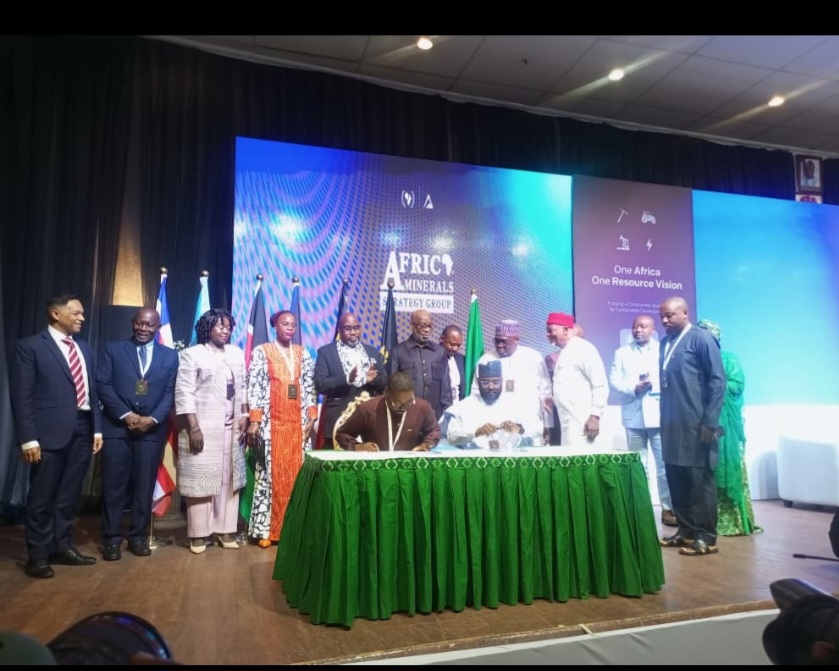
*Photo Seated R-L : Abubakar Sadiq Omar, mni, Managing Director of Steron Mining Company and Suleiman Zakari, co-founder and Executive Director of the Africans for Africa (A4A) Initiative*
Steron Mining Company has signed a strategic Memorandum of Understanding (MoU) with Africans for Africa (A4A) in a landmark move aimed at accelerating the development of Nigeria’s and Africa’s critical minerals sector, with an initial focus on lithium and rare earth elements needed for the global energy transition.
The agreement was signed during the 2026 Africa Natural Resources and Energy Investment Summit (AFNIS) held at the State House Conference Centre, Abuja, where stakeholders from across the continent gathered to deepen collaboration on Africa’s mineral development agenda.
Speaking after the signing ceremony, the Managing Director of Steron Mining Company, Abubakar Sadiq Omar, mni, described the partnership as a strategic commitment to securing Africa’s position in the rapidly expanding critical minerals market while creating opportunities for long-term industrial growth.
According to him, the partnership is designed to support the responsible development of critical mineral resources that will drive future technologies, stressing that lithium and rare earth elements have become indispensable to clean energy systems, electric vehicles, battery manufacturing and other emerging technologies.
He explained that the MoU was executed in the presence of the Chairman of the Africa Minerals Strategy Group and Nigeria’s Minister of Solid Minerals Development, Dr. Dele Alake, alongside the group’s Secretary-General and other African leaders, demonstrating a collective commitment to advancing the continent’s mineral development strategy.
Omar noted that beyond the ceremonial signing, implementation would immediately focus on positioning viable mining projects for investment while ensuring that mineral resources meet internationally acceptable standards of traceability and responsible sourcing.
“The next phase is about developing projects into investable opportunities. There is an offtake component for available resources, provided their origins are properly verified, while the next stage will involve developing projects after confirming commercially viable reserves,” he said.
He described the agreement as a major commercial breakthrough for Steron Mining, saying it provides confidence for future investments by guaranteeing market demand for minerals produced.
According to him, securing reliable offtake arrangements enables mining companies to confidently expand operations through increased investment in equipment, manpower and production capacity without the uncertainty of lacking buyers after production.
He commended the Federal Government for creating an enabling environment that has strengthened investor confidence in Nigeria’s mining industry, adding that transparent policies have made local mining companies more visible and credible before international partners.
“We are grateful to the government for providing the enabling environment that allows investments like this to happen with credibility. This agreement secures an offtake for us, which means we can confidently return to business expansion because there is assurance that the products will have a market,” he stated.
The Steron Mining boss also urged government authorities to sustain ongoing reforms in the solid minerals sector, noting that policy consistency remains essential for attracting long-term investment into mining and mineral processing.
Looking beyond mineral extraction, Omar advocated for value addition within Africa, arguing that the continent should move from being merely a supplier of raw materials to becoming a producer of finished products.
He observed that Africa remains one of the world’s largest consumer markets despite possessing enormous mineral resources, insisting that developing local processing capacity and technical skills would unlock immense economic opportunities.
“We are the source of these critical minerals, yet we consume products manufactured elsewhere. What Africa needs now is to develop the skills and industries required to process these minerals into finished products for our own benefit,” he said.
Reflecting on the challenges confronting indigenous mining companies, Omar identified youth leadership as one of the obstacles faced by emerging entrepreneurs in Africa, noting that younger business leaders often struggle for acceptance despite their capacity to drive innovation.
He, however, acknowledged the mentorship and support received from experienced industry leaders, saying such guidance has helped shape the company’s vision for contributing meaningfully to Africa’s industrial transformation.
Omar further praised the leadership of the Ministry of Solid Minerals Development, describing the current administration’s approach as timely and visionary, particularly at a period when the world is accelerating the transition from fossil fuels to cleaner energy sources.
He said the establishment of the Africa Minerals Strategy Group under the leadership of the Minister has created a platform for African countries to pursue shared interests in the development of critical minerals while positioning the continent as a key player in the global energy transition.
According to him, Africa now has a rare opportunity to industrialise by leveraging its abundant critical mineral resources, adding that collaborative initiatives such as the Steron Mining-A4A partnership would contribute significantly to achieving that objective.
Industry observers believe the agreement reinforces growing confidence in Nigeria’s mining sector and reflects increasing private-sector collaboration aimed at strengthening Africa’s role in global critical mineral supply chains while promoting sustainable economic development across the continent.







Congratulations to🎉 Steron