



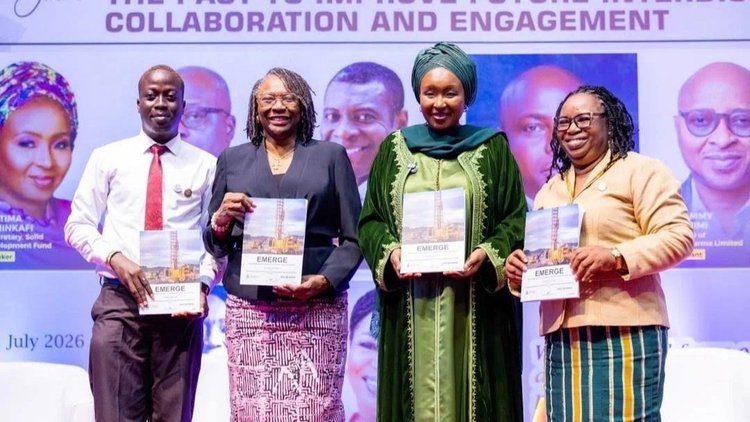

L-r:: President of the Physical and Earth Sciences Students’ Association (PESSA), University of Lagos (UNILAG), Mr. Ogunwoolu Olalabi; Vice-Chancellor, University of Lagos, Professor Folasade Ogunsola; Executive Secretary of the Solid Minerals Development Fund (SMDF), Hajiya Fatima Shinkafi; and Dean, Faculty of Physical and Earth Sciences, University of Lagos, Professor Olayinka Asekun, during the Maiden Annual Lecture Series of the Faculty of Physical and Earth Sciences at the University of Lagos on Wednesday, July 8, 2026.
The Executive Secretary of the Solid Minerals Development Fund (SMDF), Hajiya Fatima Shinkafi, has once again highlighted significant progress in Nigeria’s solid minerals sector owing to ongoing reforms.
According to her, the sector has recorded a boom of 337 per cent in two years, jumping from N16 billion revenue in 2023 to over N70 billion in 2025.
She disclosed that the sector also recorded a remarkable 33.5 per cent real growth in 2025, while reforms attracted fresh investment commitments worth about $2.6 billion, including a $1.3 billion alumina refinery described as the single biggest mining investment in Nigeria’s history.
According to a statement by SMDF spokesperson Idowu Jokpeyibo on Thursday, Shinkafi revealed these during her keynote address at the maiden Annual Lecture Series of the Faculty of Physical and Earth Sciences at the University of Lagos (UNILAG), on Thursday.
The lecture, held at the J.F. Ade-Ajayi (Main) Auditorium, had the theme: “Industry and Academia: Understanding the Past to Improve the Future Interdisciplinary Collaboration and Engagement.”
It brought together leading figures from academia, government and industry.
Shinkafi used the occasion to call for stronger collaboration among government, industry and academia to unlock Nigeria’s vast mineral wealth.
The SMDF boss said Nigeria possesses more than 44 commercially viable minerals across over 500 locations, including gold, lithium, iron ore, coal, bitumen, barite and gemstones, but lamented that the sector still contributes less than one per cent to the country’s GDP.
According to her, solid mineral exports stood at about ₦354 billion in 2025, accounting for only 0.4 per cent of Nigeria’s total exports and about three per cent of non-oil exports.
She said the reforms introduced as part of President Bola Tinubu’s Renewed Hope Agenda has begun yielding measurable results, with revenue from the sector increasing in bounds.
“The clearest proof sits in federation revenues. In 2023, this sector earned the Federation about ₦16 billion. In 2024, the figure rose to ₦38 billion. In 2025, it crossed ₦70 billion. That is growth of more than 337 per cent in two years,” she said.
“The national accounts tell the same story, in real terms, with the price effect stripped out. The sector grew 33.5 per cent in real terms in 2025, roughly nine times the overall economy’s 3.9 per cent real growth.
Shinkafi added that the sector recorded 33.5 per cent real growth in 2025—about nine times the overall economic growth rate of 3.9 per cent—and had attracted approximately $2.6 billion in fresh investment commitments since 2023, including a $1.3 billion alumina refinery project described as the largest mining investment in Nigeria’s history.
Despite these, she said, the sector historically underperformed, even though the country possesses more than 44 commercially viable minerals across over 500 locations.
She said solid minerals currently contribute less than one per cent to the nation’s GDP, while exports from the sector stood at approximately ₦354 billion in 2025, representing about 0.4 per cent of total exports and roughly three per cent of non-oil exports.
According to her, this contrasts sharply with the period immediately after independence when mining accounted for nearly five per cent of Nigeria’s total exports.
Shinkafi said reforms introduced under President Bola Ahmed are repositioning the sector for sustainable growth.
Shinkafi reiterated FG’s ambition to expand Nigeria’s solid minerals industry 25-fold to about N30tn, equivalent to approximately $21bn, by 2030 as reforms in the sector continue to attract fresh investments and significantly increase government revenue.
“The Federal Government’s target is a 25-fold expansion of the sector, to roughly N30tn (about US$21bn) by 2030,” she said.
Shinkafi also highlighted the SMDF’s Early-Stage Mineral Exploration and Research Grant Endowment (EMERGE), launched in June 2026, describing it as Nigeria’s first dedicated competitive funding programme for geoscience research in universities.
According to her, EMERGE comprises three funding streams—Exploration, Critical Minerals, and Research and Development—with grants covering up to 100 per cent of eligible costs for research, including fieldwork, laboratory testing and publication fees.
“EMERGE is the first time in Nigeria’s history that a national institution has created dedicated, competitive funding for geoscience research in our universities,” she said, urging researchers to take advantage of the initiative.
She noted that beneficiaries would also participate in the EMERGE Accelerator, which provides technical training, investment-readiness support and access to follow-on funding.
Encouraging greater female participation in the mining industry, Shinkafi drew inspiration from pioneering scientist Marie Curie, telling young women at the event that, “The minerals under our feet do not care who unlocks them.”
Turning to the high table, Shinkafi noted that the keynote lecture featured three women in leadership positions and encouraged more young women to pursue careers in mining and geosciences.
In her welcoming remarks, the Vice-Chancellor of the University of Lagos, Professor Folasade Ogunsola, described the lecture as a demonstration of the role of partnerships between research institutions and public agencies in national development.
“The University of Lagos is proud to convene the maiden edition of this lecture series and to place our Faculty of Physical and Earth Sciences at the service of a national priority. A partnership between a research university and a sovereign fund is how knowledge becomes national wealth,” she said.
The Dean of the Faculty of Physical and Earth Sciences, Professor Olayinka Taiwo Asekun, said the lecture series was established to strengthen collaboration between academia and industry.
She described the EMERGE initiative as a unique opportunity for researchers to translate academic work into practical mining solutions and pledged that the faculty would ensure strong participation in subsequent application windows.