





By Engel Schmidl
Three developments in the past week have highlighted a growing reality for Australian mining: success in critical minerals is increasingly being shaped not just by geology, project economics and engineering, but also by international relations and diplomacy.
As Western nations seek to diversify critical minerals supply chains, Australian resource companies are finding themselves at the intersection of trade policy, national security and global industrial strategy. Recent developments involving Arafura Rare Earths, Fortescue and the Quad partnership (Australia, India, Japan and the US) demonstrate how international cooperation is becoming a critical factor in determining which projects advance and which supply chains emerge.
Diplomacy drives development

The clearest example came with Arafura Rare Earths reaching a final investment decision (FID) for its Nolans rare earths project in the Northern Territory after more than 20 years of planning and development. While the FID marks a significant milestone, the project also serves as a case study in how critical minerals developments are increasingly reliant on international partnerships.
In announcing the decision, Arafura described Nolans as being at the centre of international efforts to diversify critical minerals supply chains involving Australia, the US, Germany, Canada and South Korea.
The project has secured offtake agreements with European, Korean and North American customers, while also attracting support from export credit agencies in the US, Canada, Germany and South Korea.
That international coalition has become a fundamental part of the project’s development pathway.
Arafura managing director Darryl Cuzzubbo said the company’s customer base and government support reflect the strength of international demand for alternative rare earth supply chains outside China.
“The offtake relationships we have established with Hyundai, Kia, Siemens Gamesa, Traxys and the various types of economic support provided by the Australian Government are not transactional arrangements,” Cuzzubbo said.
“They reflect a shared recognition that the diversification of global rare earth supply chains is an imperative, not merely an opportunity.”
The significance of Nolans extends beyond the project itself. It demonstrates how governments and industrial customers are increasingly willing to work together to support projects that can provide strategic alternatives in critical minerals supply chains.
Global expertise gains value
A second example of the importance of international diplomacy emerged this week with Fortescue’s appointment of Sigrid Kaag as a non-executive director.
Kaag brings a 35-year career in international affairs, trade and finance, including serving as First Deputy Prime Minister and Minister of Finance of the Netherlands.
Her appointment comes shortly after the conclusion of the Australia–European Union Free Trade Agreement earlier this year and highlights the growing value resource companies are placing on international expertise.
Fortescue executive chairman Andrew Forrest said Kaag will bring valuable experience to the company’s future direction.
“Sigrid is an outstanding global leader with deep diplomatic expertise and a strong understanding of the Middle East, North Africa and European energy markets,” Forrest said.
“Her experience across governments, international institutions and multilateral finance will bring valuable perspective to Fortescue as we continue to grow, diversify and advance our leadership in delivering green solutions and eliminating fossil fuels from heavy industry.”
The appointment reflects the increasingly complex global environment in which mining companies operate. Beyond commodity markets, miners must navigate varying regulatory frameworks, sustainability requirements, investment expectations and geopolitical considerations.
From mining policy to foreign policy
The third development came through the announcement of the Quad Critical Minerals Initiative, involving Australia, India, Japan and the US.
The initiative aims to strengthen diversified supply chains across mining, processing and recycling and will seek to mobilise up to $20 billion in government and private sector support through new and existing efforts.
According to a joint ministerial statement, the Quad partners intend to use “economic policy tools and coordinated investment” to accelerate the development of diversified and fair critical minerals markets.
The framework focuses on three key areas: investment and project development, regulatory alignment and broader development settings, and recycling and recovery.
Taken together, these developments suggest critical minerals are increasingly being viewed through a strategic lens by governments and industry alike.
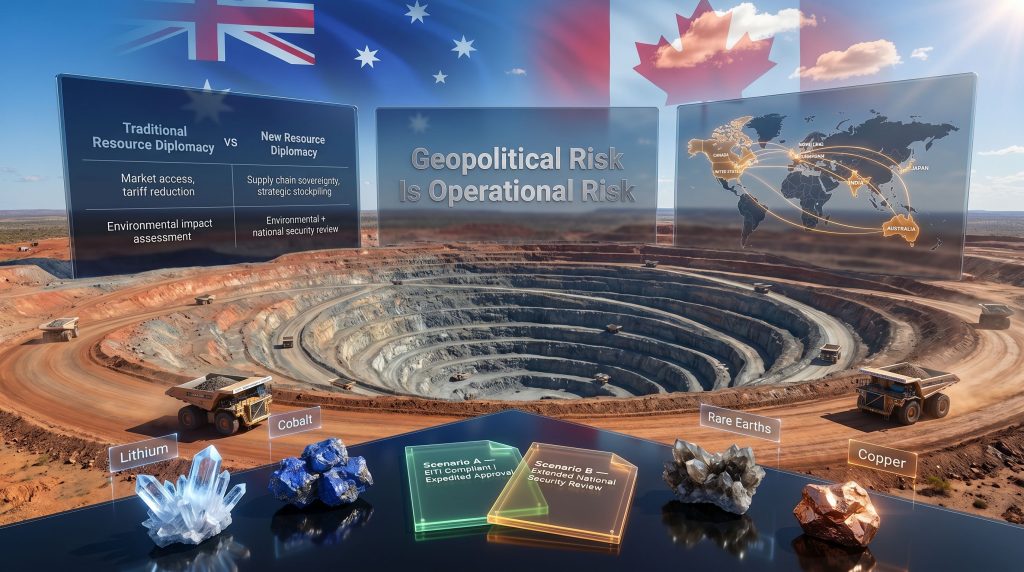
Former Australian Foreign Affairs Minister, Julia Bishop recently captured that shift when she told a Perth mining event that minerals and metals are now at “the epicentre of great power competition”.
“Today it is inextricably tied to national security diplomacy,” Bishop said. “Industry needs a seat at the diplomatic table.”
Control of critical mineral extraction and processing, Bishop said, will carry increasing influence in coming decades.
“In trade talks we used to focus on market access and tariff schedules and the like, but it’s now supply chain resilience, strategic stockpiling and the importance of trusted, reliable, long-term partners,” Bishop said.
“Mines and processing facilities and transport infrastructure are now viewed as assets in a strategic calculation that extends well beyond a company’s balance sheet.”
For Australian miners, particularly those operating in critical minerals, project success is no longer determined by resource quality and market demand. It is also shaped by the ability to align with the strategic priorities of governments and industrial partners seeking secure and diversified supply chains.
As Bishop said, governments are increasingly prepared to support private sector projects through diplomatic engagement, partnerships and financial backing.
“The opportunity … is that governments, including the Australian Government, are more willing to actively support and partner with private sector companies, essentially to secure resource supply chains,” she said.
“Critical mineral strategies in Australia, the US, Japan, India, the EU are all about diplomatic and financial capital. Partnerships, loan guarantees, diplomatic support for projects are much more likely now than they ever were before.”
For an industry traditionally focused on rocks, grades and production, diplomacy is rapidly becoming another critical resource.
*Credit: Australian Mining