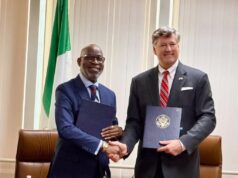


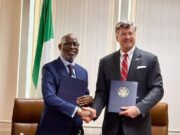
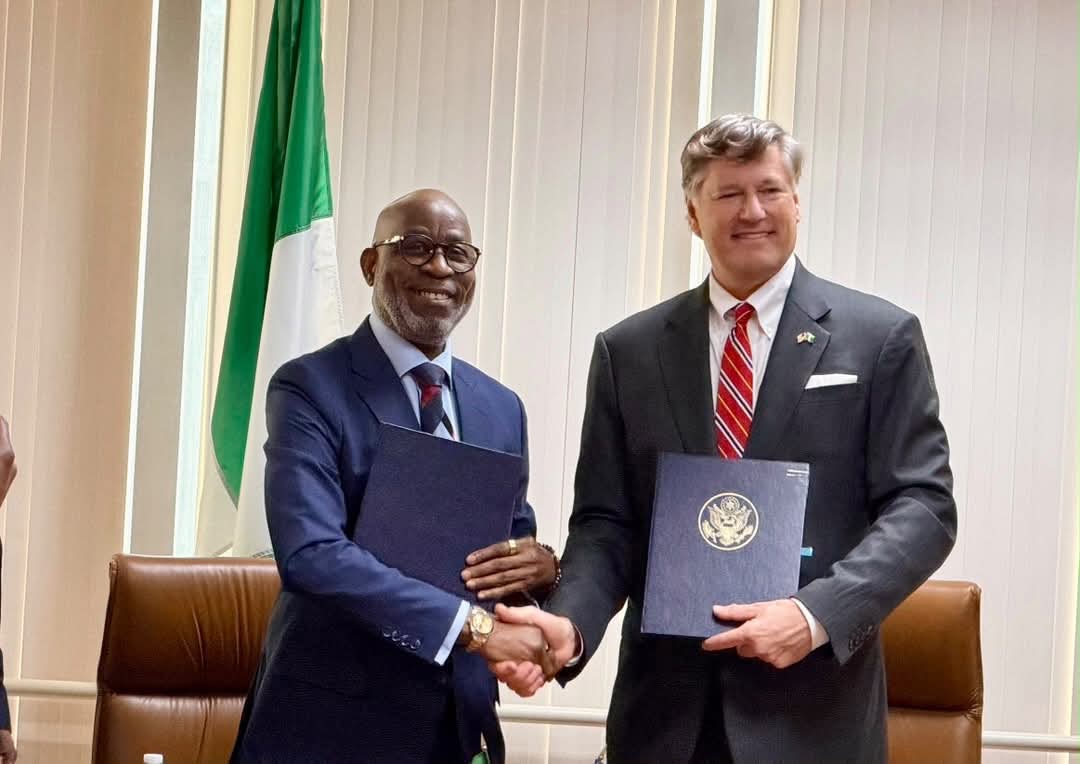
*Dr Alake (left) with Christopher Landau
The Health of Mother Earth Foundation (HOMEF) has called on the Federal Government to provide the public and civil society with the full details of the recent MoU on mining reached with the government of the United States.

HOMEF, in a statement issued today in Benin, said there is need to move beyond high-level announcements to clarify the specific environmental, labour, and fiscal obligations involved and to remember that Nigeria’s long-term prosperity lies in the preservation of its ecosystems and the empowerment of its people, not in becoming a primary resource repository for foreign industrial powers
HOMEF, in the statement, also called on all stakeholders to remain vigilant and to demand that any mineral development framework prioritise the well-being of Nigerian communities and the preservation of the nation’s natural heritage.
It also advised host communities, Civil Society Organisations (CSOs), and relevant stakeholders to approach this agreement with heightened scrutiny, focusing on four critical areas of vulnerability that require immediate attention.
The Federal Government of Nigeria and the United States on September 23, 2026, signed a Memorandum of Understanding (MoU) to boost American investment in Nigeria’s estimated $700 billion mining sector. Nigeria’s Solid Minerals Minister, Dele Alake, and US Deputy Secretary of State, Christopher Landau, signed the agreement on the sidelines of the United Nations General Assembly, with claims that it would diversify Nigeria’s economy away from oil and secure critical mineral supply chains for the US.
“While the government frames this partnership as a pathway to economic diversification, Health of Mother Earth Foundation (HOMEF) views the agreement with significant scepticism, warning that it may inadvertently accelerate a cycle of extractivism that prioritises global supply chain security over the rights and well-being of Nigerian communities,” the statement said. “The extraction of critical minerals, particularly lithium, can be an environmentally destructive enterprise.
“It poses an existential threat of irreversibly depleting and contaminating local water tables, poisoning agricultural land, and disrupting agrarian livelihoods. This trajectory leaves host communities to bear the long-term toxic liabilities of extraction without equitable benefit. There is a structural risk that the rush to satisfy foreign capital will incentivise the government to fast-track mineral title approvals by circumventing robust Social and Environmental Impact Assessments (EIAs) and compromising the integrity of Community Development Agreements (CDAs) mandated under Section 116 of 2027. Such shortcuts would fundamentally undermine the legal and social protections designed to safeguard affected populations.
HOMEF Executive Director, Dr Nnimmo Bassey, said economic model replicates the Niger Delta’s devastating history.
“We must not reproduce that environmental genocide by replacing oil with minerals while sacrificing lives, lands, and ecosystems, ” he said. “This agreement, while cloaked in the language of economic growth, threatens to entrench the same pattern of extractivism that has devastated the Niger Delta for decades. We have seen how international mining interests operate when oversight is weak, and profit is the sole motivation. Without stringent safeguards, this MoU risks turning our mineral wealth into a resource curse, leaving behind degraded landscapes and impoverished communities rather than sustainable development.”
Bassey further cited the recent tragic deaths of 37 young miners in Niger State custody as an indictment of Nigeria’s extractive economy.
“We are deeply concerned that the rush to feed global demand for critical minerals will be prioritised over the livelihoods, health, and sovereignty of Nigerian communities. Strategic vigilance is required to ensure that our minerals serve our own development needs first, and that the rights of local people are protected against land dispossession and pollution,” he said.
HOMEF cautions that the global demand for critical minerals such as lithium, cobalt, nickel, and copper often drives rapid industrial expansion that ignores the ecological integrity of host regions that have suffered ecological disaster.