







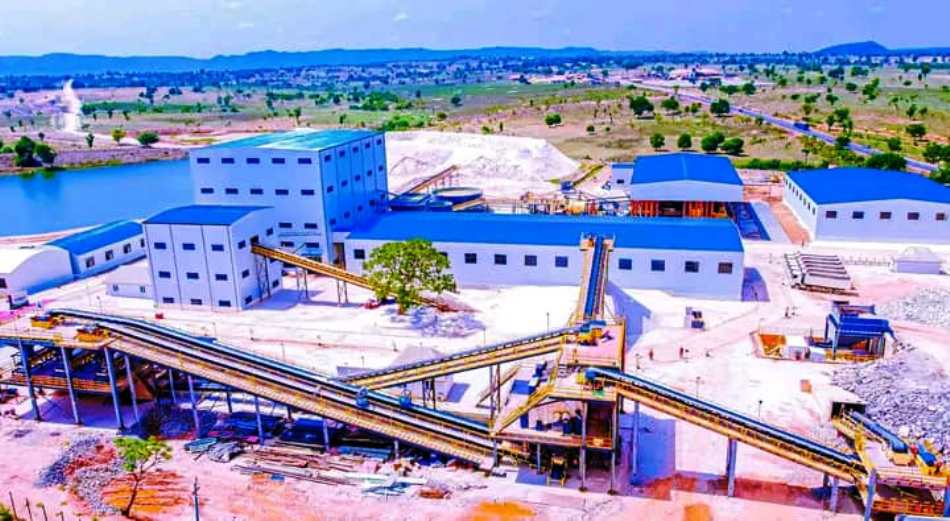

*A Lithium Processing Plant In Nigeria.
For decades, Nigeria’s economic narrative was trapped in a single chapter: crude oil. However, a quiet but rapid transformation is taking place beneath the soil. Driven by aggressive institutional changes and an unprecedented global rush for energy-transition minerals, Nigeria’s solid minerals sector is undergoing an expansion.
Recent data reveals that the solid minerals sector has recorded a 337% revenue surge, moving from ₦16 billion in 2023 to over ₦70 billion projected by the close of 2026.
Concurrently, the sector’s contribution to Nigeria’s Gross Domestic Product (GDP) climbed sharply from a historical average of less than 0.5% to 1.8%, posting an impressive over 4.61% growth rate in the last quarter of 2025 bringing the total fiscal revenue above N70 billion projection for 2026.

While these fiscal figures capture the interest of macroeconomic analysts, the real impact is felt on the streets, where job creation is rising rapidly.

Historically, Nigeria suffered from a “pit-to-port” model—extracting crude mineral resources and shipping them raw, which exported domestic jobs to foreign processing hubs. To halt this economic drain, the Federal Government, through the Ministry of Solid Minerals Development, implemented a strict “value-addition” policy. This mandate stipulates that processing and refining must take place locally before export approvals are granted.
This regulatory pivot has attracted over $2.6 billion in foreign direct investment (FDI) into midstream processing ventures.
The resulting jobs boom spans both mega-scale industrial plants and local community operations:
The Lithium Rush: In Nasarawa State, a new rare earth and lithium processing industrial park is generating massive local employment. The flagship facility alone is set to create 10,000 direct and indirect jobs, fundamentally transforming the regional labor market.
Industrial Footprints: Similar midstream operations are springing up nationwide. These include a $50 million lithium facility in the Federal Capital Territory (FCT) and a landmark $1.3 billion alumina refinery agreement signed with the Africa Finance Corporation (AFC) This project will process one million tonnes of bauxite annually, opening thousands of positions for chemical engineers, plant operators, and heavy machinery technicians.
Downstream Integration: In Lagos, the launching of local gold refineries has established an entirely new urban ecosystem of precious metal assayers, security logistics personnel, and trade compliance officers.
The vast majority of Nigerian mining historically occurred in the informal sector, driven by over an estimated million artisanal miners working without state oversight. Through the government’s Renewed Hope Agenda, the state has prioritized formalizing these operations by organizing independent miners into structured cooperatives.
This formalization effort has yielded immediate results for local communities. For instance, in Plateau State—a region rich in tin, columbite, and gemstones—the re-organization of youth miners into legal cooperatives has stabilized livelihoods. Mining royalties remitted from the state surged from ₦30 million monthly to between ₦300 million and ₦350 million, showcasing the vast scale of formalized local trade.
By providing micro-funding through the upgraded Solid Mineral Development Fund (SMDF) and enforcing safer workplace standards, informal laborers are transforming into sustainable, tax-paying entrepreneurs.
Despite these positive developments, sector analysts urge cautious optimism. Leading multi-national professional networks, including PricewaterhouseCoopers (PwC), emphasize that while progress is undeniable, structural vulnerabilities remain.
In recent briefs from the Nigerian Economic Summit Group (NESG), experts note that to hit the government’s target of 500,000 formal mining jobs by 2030, the country must aggressively tackle infrastructure deficits.
“The legislative frameworks and the influx of processing factories are steering Nigeria in the correct direction,” notes an industrial policy expert from the NESG. “However, long-term employment stability depends on two pillars: securing mining fields from regional instability and resolving the transport logistics required to move bulk minerals efficiently from interior states to coastal shipping hubs.”
The government has responded by deploying a specialized force of Mining Marshals alongside nationwide satellite surveillance to secure resource-rich regions.
If these security measures hold, Nigeria’s mining sector is well-positioned to serve as a primary engine for domestic employment through the end of the decade.