

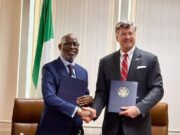




*Photo L-R: Governor Agbu Kefas of Taraba State and Denzel Henry Akogwu, Principal Chief Executive Officer of Elipse International Ltd*
I have followed with concern the recent reports and public discussions regarding mining activities in Taraba State and the recent suspension announcement circulating within the mining industry.

Elipse International Ltd , as one of the leading indigenous mining companies with interests in Taraba State, we were surprised by the recent pronouncement. This is because, to the best of our knowledge, there was never a public announcement indicating that Executive Order No. 5, signed by His Excellency Governor Dr. Agbu Kefas on 23 August 2023, had been lifted.
As far as Elipse International Ltd and many stakeholders in the mining industry are aware, Executive Order No. 5 remains in force.
Consequently, the recent suspension announcement has raised important questions within the industry regarding its practical effect and the future direction of mining policy within the state.
The mining sector depends heavily on policy certainty, regulatory consistency, and investor confidence. Investors, operators, financial institutions, contractors, service providers, and host communities all benefit when government policies are clearly communicated and consistently applied.
The uncertainty generated by recurring restrictions and suspension announcements risks creating an environment in which investors become reluctant to commit long-term capital to the development of the state’s mineral resources.
Mining remains one of the most important opportunities available to Nigeria for economic diversification, job creation, rural development, foreign exchange earnings, infrastructure growth, and the reduction of insecurity.
Across the world, successful mining jurisdictions have demonstrated that responsible mining operations contribute significantly to local economic development and social stability.
The presence of successful mining operations creates employment opportunities for youths, stimulates local businesses, increases internally generated revenue, supports infrastructure development, and helps reduce insecurity by providing legitimate economic opportunities for local populations.
In my view, the solution is not the prolonged suspension of legitimate mining activities. Rather, the focus should be on strengthening regulatory oversight, enforcing environmental compliance, ensuring community participation, and eliminating illegal mining operations.
The Federal Government, under the leadership of the Honourable Minister of Solid Minerals Development, Henry Dele Alake, has undertaken significant reforms to reposition Nigeria’s mining sector and improve its image before the international investment community. These efforts have attracted growing attention from international investors, development finance institutions, commodity traders, and mining companies seeking opportunities within Nigeria.
Taraba State possesses substantial deposits of strategic minerals, including lithium, graphite, gold, tin, and other critical minerals capable of transforming local communities and contributing significantly to both state and national economic growth.
One important aspect often overlooked in discussions about mining development is the role played by local scouts, prospectors, and indigenous entrepreneurs.
The reality is that neither the Federal Government nor state governments possess sufficient resources to conduct detailed exploration activities across every part of Nigeria.
Much of the information that ultimately leads to mineral discoveries originates from local scouts, prospectors, artisanal operators, community members, and indigenous entrepreneurs who spend years identifying mineral occurrences in remote locations.
Many of Nigeria’s known mineral occurrences were initially identified through local knowledge and grassroots prospecting efforts before substantial investments were committed. These discoveries subsequently generate applications through the Nigerian Mining Cadastre Office and provide valuable information that assists the Nigerian Geological Survey Agency (NGSA) in understanding the country’s mineral potential and determining where future geological investigations should be concentrated.
For this reason, policies that discourage exploration activity or create uncertainty within the sector may unintentionally reduce future discoveries and limit the growth of the industry.
Nigeria should encourage responsible exploration and create an environment that rewards initiative, compliance, and investment. The more exploration that takes place, the greater the likelihood of new discoveries, increased geological knowledge, more licence applications, more investment opportunities, and ultimately more mining projects.
Furthermore, consideration should be given to the impact that prolonged restrictions may have on existing mineral title holders. Many companies have invested substantial resources in acquiring licences, conducting exploration, engaging host communities, meeting regulatory obligations, and developing mining projects.
Where operators are unable to carry out activities due to circumstances beyond their control, legitimate concerns naturally arise regarding the preservation of the value and tenure of mineral titles.
Stakeholders should engage constructively on mechanisms that ensure legitimate licence holders are not unfairly disadvantaged by prolonged suspensions or administrative restrictions.
Such mechanisms may include extensions of operational timelines, preservation of licence tenure, regulatory relief measures, or other lawful remedies that protect investments while maintaining compliance with applicable laws and regulations.
I also respectfully encourage the Federal Government to continuously review annual service fees and regulatory costs to ensure they do not become barriers to entry for indigenous companies and genuine exploration entrepreneurs. The objective should be to encourage broader participation in the mining industry rather than concentrating opportunities among only a limited number of operators.
Policy discussions should not focus solely on lithium. Nigeria possesses significant deposits of manganese, graphite, copper, gold, lead, zinc, tin, tungsten, rare earth minerals, and numerous other strategic commodities capable of generating substantial economic value. A diversified approach to mineral development will create a stronger and more resilient mining sector.
I respectfully encourage the Government of Taraba State to engage stakeholders across the mining industry and reconsider policies that may discourage responsible investment. If additional oversight mechanisms are required, such frameworks can be developed in partnership with the Federal Ministry of Solid Minerals Development, the Federal Mines Office, the Nigerian Mining Cadastre Office, and the Nigerian Geological Survey Agency to ensure compliance while allowing legitimate businesses to operate.
The objective should be simple: encourage investment, strengthen regulation, eliminate illegal mining, create jobs, improve security, increase government revenue, support local communities, and allow Taraba State to realise the full value of its mineral resources.
Taraba State has enormous potential. With stable policies, effective regulation, and constructive engagement between government and industry, the state can emerge as one of Nigeria’s leading mining destinations.
The future of mining in Nigeria should be built on partnership, compliance, investment, exploration, and sustainable development—not uncertainty.
If we allow the sector to thrive, we will encourage more discoveries, attract more investment, create more jobs, strengthen local economies, improve security, and position both Taraba State and Nigeria as leading mining destinations in Africa.